Review : Taylor Series — Question 4

PDF ↗

Question 4

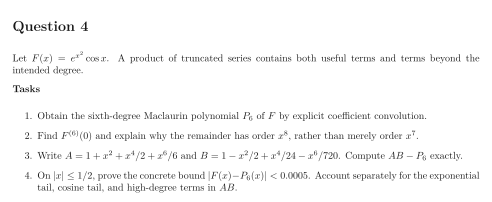
Let F(x)=ex2cos⁡xF(x)=e^{x^2}\cos x. A product of truncated series contains both useful terms and terms beyond the intended degree.

Tasks

  1. Obtain the sixth-degree Maclaurin polynomial P6P_6 of FF by explicit coefficient convolution.

  2. Find F(6)(0)F^{(6)}(0) and explain why the remainder has order x8x^8, rather than merely order x7x^7.

  3. Write A=1+x2+x4/2+x6/6A=1+x^2+x^4/2+x^6/6 and B=1−x2/2+x4/24−x6/720B=1-x^2/2+x^4/24-x^6/720. Compute AB−P6AB-P_6 exactly.

  4. On |x|≤1/2|x|\le 1/2, prove the concrete bound |F(x)−P6(x)|<0.0005|F(x)-P_6(x)|<0.0005. Account separately for the exponential tail, cosine tail, and high-degree terms in ABAB.

Original worksheet page 1: question and worked solution for 6-2-004
Show solutionHide solution

Question 4 – Solution

Strategy. Convolve by degree, then bound the two truncation errors and the discarded product terms separately.

Step 1: Collect only the requested powers. Using the entire exponential and cosine series, [x2]F=1−12=12,[x4]F=12−12+124=124,[x^2]F=1-\tfrac 12=\tfrac 12,\quad [x^4]F=\tfrac 12-\tfrac 12+\tfrac 1{24}=\tfrac 1{24}, [x6]F=16−14+124−1720=−31720.[x^6]F=\tfrac 16-\tfrac 14+\tfrac 1{24}-\tfrac 1{720}=-\tfrac{31}{720}. Thus P6(x)=1+x2/2+x4/24−31x6/720\boxed{P_6(x)=1+x^2/2+x^4/24-31x^6/720}.

Step 2: Recover a derivative and its parity. We have F(6)(0)=6!(−31/720)=−31F^{(6)}(0)=6!(-31/720)=-31. Both factors are even and analytic everywhere, so all odd coefficients vanish. The next possible power after degree six is eight, proving F−P6=O(x8)F-P_6=O(x^8) near 00.

Step 3: Retain the discarded product explicitly. Direct multiplication gives AB−P6=−23360x8+1160x10−14320x12.AB-P_6=-\frac{23}{360}x^8+\frac 1{160}x^{10}-\frac 1{4320}x^{12}. These terms belong to the product of polynomials, not to P6P_6.

Step 4: Certify the error on the whole interval. Write E=ex2E=e^{x^2} and C=cos⁡xC=\cos x. Then EC−P6=(E−A)C+A(C−B)+(AB−P6)EC-P_6=(E-A)C+A(C-B)+(AB-P_6). For |x|≤1/2|x|\le 1/2, |C|≤1|C|\le 1, 0<A≤e1/4<4/30<A\le e^{1/4}<4/3 (compare the exponential series with the geometric series). Taylor’s theorem and the alternating cosine tail give |E−A|≤43|x|824,|C−B|≤|x|88!.|E-A|\le\frac 43\frac{|x|^8}{24},\qquad |C-B|\le\frac{|x|^8}{8!}. Consequently, |F−P6|≤4/324⋅256+4/340320⋅256+23360⋅256+1160⋅1024+14320⋅4096<0.000473<0.0005.|F-P_6|\le\frac{4/3}{24\cdot 256}+\frac{4/3}{40320\cdot 256} +\frac{23}{360\cdot 256}+\frac 1{160\cdot 1024} +\frac 1{4320\cdot 4096}<0.000473<0.0005. The bound is conservative but rigorous; no unbounded OO-term is used as a numerical certificate.
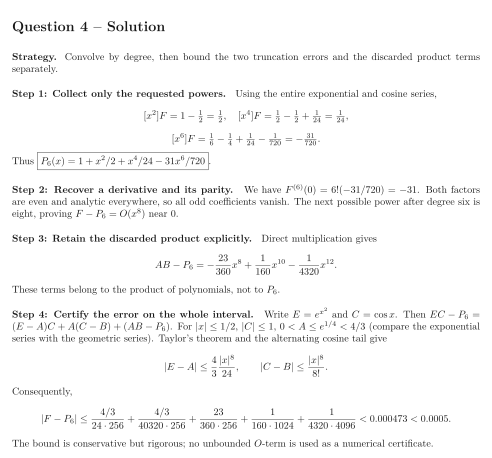
Original worksheet page 2: question and worked solution for 6-2-004

Original worksheet layout. Use Enlarge or open the PDF for a closer view.