Question 2
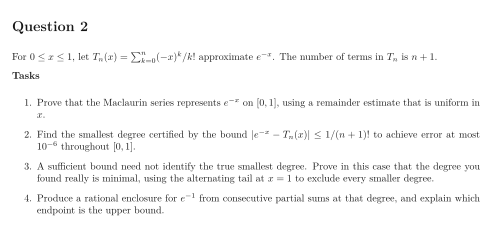
For , let approximate . The number of terms in is .
Tasks
Prove that the Maclaurin series represents on , using a remainder estimate that is uniform in .
Find the smallest degree certified by the bound to achieve error at most throughout .
A sufficient bound need not identify the true smallest degree. Prove in this case that the degree you found really is minimal, using the alternating tail at to exclude every smaller degree.
Produce a rational enclosure for from consecutive partial sums at that degree, and explain which endpoint is the upper bound.
Show solutionHide solution
Question 2 – Solution
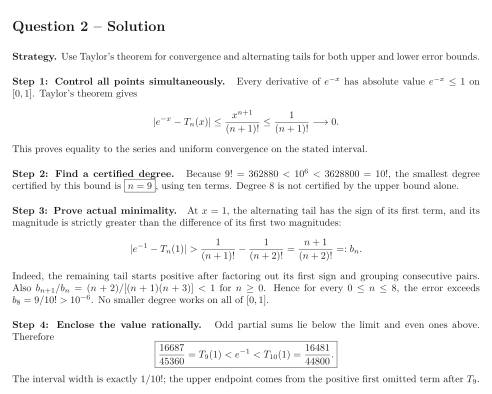
Strategy. Use Taylor’s theorem for convergence and alternating tails for both upper and lower error bounds.
Step 1: Control all points simultaneously. Every derivative of has absolute value on . Taylor’s theorem gives This proves equality to the series and uniform convergence on the stated interval.
Step 2: Find a certified degree. Because , the smallest degree certified by this bound is , using ten terms. Degree is not certified by the upper bound alone.
Step 3: Prove actual minimality. At , the alternating tail has the sign of its first term, and its magnitude is strictly greater than the difference of its first two magnitudes: Indeed, the remaining tail starts positive after factoring out its first sign and grouping consecutive pairs. Also for . Hence for every , the error exceeds . No smaller degree works on all of .
Step 4: Enclose the value rationally. Odd partial sums lie below the limit and even ones above. Therefore The interval width is exactly ; the upper endpoint comes from the positive first omitted term after .