Question 1
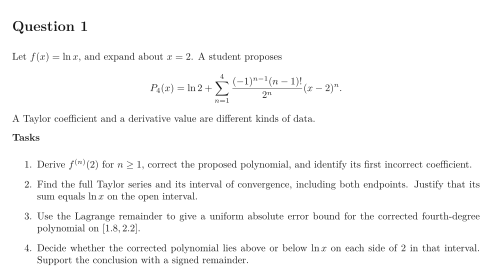
Let , and expand about . A student proposes A Taylor coefficient and a derivative value are different kinds of data.
Tasks
Derive for , correct the proposed polynomial, and identify its first incorrect coefficient.
Find the full Taylor series and its interval of convergence, including both endpoints. Justify that its sum equals on the open interval.
Use the Lagrange remainder to give a uniform absolute error bound for the corrected fourth-degree polynomial on .
Decide whether the corrected polynomial lies above or below on each side of in that interval. Support the conclusion with a signed remainder.
Show solutionHide solution
Question 1 – Solution
Strategy. Divide derivatives by factorials, then distinguish series convergence from finite-polynomial accuracy.
Step 1: Normalize the coefficients. For , . Thus The student omitted division by ; the first error is the coefficient, instead of .
Step 2: Establish the represented function. Integrating the geometric series for from to gives for . Uniform convergence on the integration segment justifies this step. The term ratio tends to , so the radius is ; gives the divergent negative harmonic series and gives the alternating harmonic series. The convergence interval is in .
Step 3: Certify a uniform error. Since , on ,
Step 4: Determine the error sign. For , for some positive between and . Thus is above on and below it on ; equality holds at . The plot magnifies this signed error.
See the diagram in the original worksheet below.
