Question 10
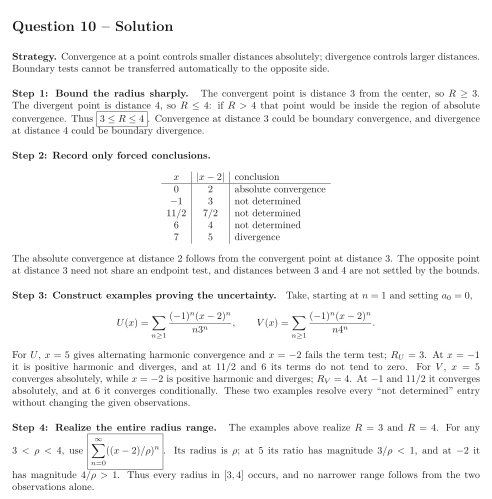
An unknown real power series converges at and diverges at . No coefficient formula is supplied. Use only what these two observations imply; boundary convergence may be conditional.
Tasks
Find the strongest possible bounds on its radius of convergence . Explain why either inequality may be an equality.
Classify the behavior forced at : absolute convergence, divergence, or not determined by the information. Give reasons using distances from the center.
Construct two explicit series satisfying both observations that establish all the undetermined cases in your table. Verify the observations and the disputed points for each example.
Show every radius in your proposed closed range can occur. Use explicit examples for the endpoints and a general construction for the intermediate radii.
Show solutionHide solution
Question 10 – Solution
Strategy. Convergence at a point controls smaller distances absolutely; divergence controls larger distances. Boundary tests cannot be transferred automatically to the opposite side.
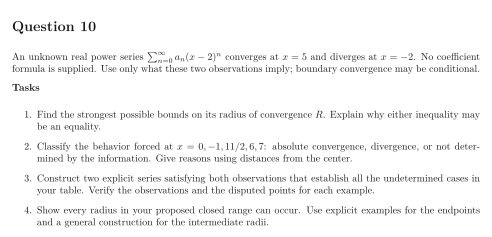
Step 1: Bound the radius sharply. The convergent point is distance from the center, so . The divergent point is distance , so : if that point would be inside the region of absolute convergence. Thus . Convergence at distance could be boundary convergence, and divergence at distance could be boundary divergence.
Step 2: Record only forced conclusions. The absolute convergence at distance follows from the convergent point at distance . The opposite point at distance need not share an endpoint test, and distances between and are not settled by the bounds.
Step 3: Construct examples proving the uncertainty. Take, starting at and setting , For , gives alternating harmonic convergence and fails the term test; . At it is positive harmonic and diverges, and at and its terms do not tend to zero. For , converges absolutely, while is positive harmonic and diverges; . At and it converges absolutely, and at it converges conditionally. These two examples resolve every “not determined” entry without changing the given observations.
Step 4: Realize the entire radius range. The examples above realize and . For any , use . Its radius is ; at its ratio has magnitude , and at it has magnitude . Thus every radius in occurs, and no narrower range follows from the two observations alone.