Question 9
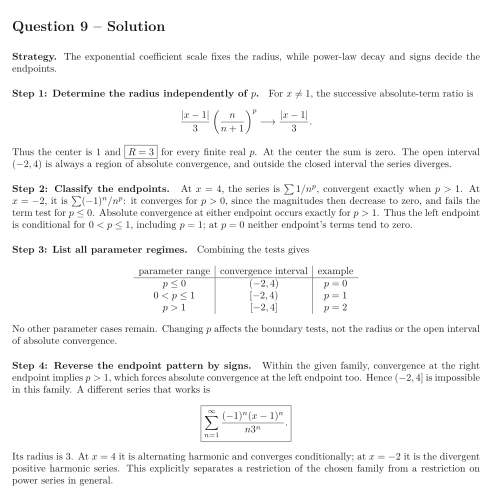
For a real parameter , consider Use this family to investigate which endpoint patterns can be designed by changing coefficient decay, and which require changing coefficient signs.
Tasks
Find the center and radius for every real , including .
Give a complete classification of convergence and absolute convergence at both endpoints as varies. Include the threshold cases and .
Determine all yielding each of the intervals , and . Supply one concrete value for each pattern.
Can any member of this family have convergence interval ? Prove your answer, then construct another power series centered at with radius and exactly that interval.
Show solutionHide solution
Question 9 – Solution
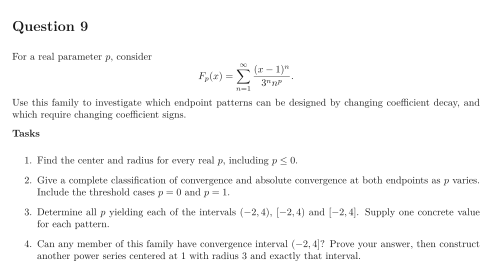
Strategy. The exponential coefficient scale fixes the radius, while power-law decay and signs decide the endpoints.
Step 1: Determine the radius independently of . For , the successive absolute-term ratio is Thus the center is and for every finite real . At the center the sum is zero. The open interval is always a region of absolute convergence, and outside the closed interval the series diverges.
Step 2: Classify the endpoints. At , the series is , convergent exactly when . At , it is : it converges for , since the magnitudes then decrease to zero, and fails the term test for . Absolute convergence at either endpoint occurs exactly for . Thus the left endpoint is conditional for , including ; at neither endpoint’s terms tend to zero.
Step 3: List all parameter regimes. Combining the tests gives No other parameter cases remain. Changing affects the boundary tests, not the radius or the open interval of absolute convergence.
Step 4: Reverse the endpoint pattern by signs. Within the given family, convergence at the right endpoint implies , which forces absolute convergence at the left endpoint too. Hence is impossible in this family. A different series that works is Its radius is . At it is alternating harmonic and converges conditionally; at it is the divergent positive harmonic series. This explicitly separates a restriction of the chosen family from a restriction on power series in general.