Question 8
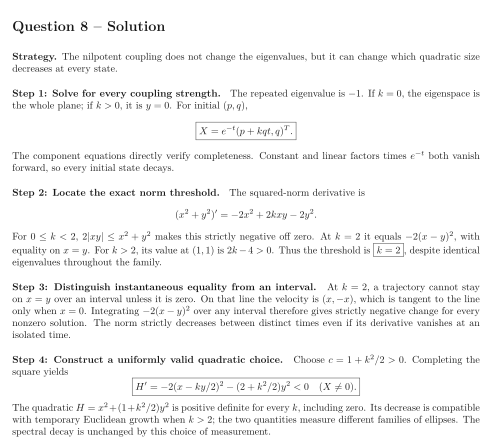
For , consider Investigate Euclidean monotonicity and construct an alternative quadratic size when the standard squared norm is unsuitable.
Tasks
Find the complete solution and classify the eigenspace dimension as varies. Prove forward decay for all initial data.
Classify all for which is negative at every nonzero state, nonpositive with nonzero equality states, or positive at some state.
At the boundary parameter between those cases, decide whether the norm strictly decreases between any two distinct times along every nonzero solution. Address the instantaneous equality line.
Choose a positive coefficient so that has strictly negative derivative at every nonzero state for every . Give an explicit choice and proof.
Show solutionHide solution
Question 8 – Solution
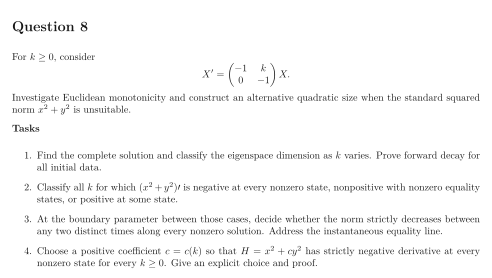
Strategy. The nilpotent coupling does not change the eigenvalues, but it can change which quadratic size decreases at every state.
Step 1: Solve for every coupling strength. The repeated eigenvalue is . If , the eigenspace is the whole plane; if , it is . For initial , The component equations directly verify completeness. Constant and linear factors times both vanish forward, so every initial state decays.
Step 2: Locate the exact norm threshold. The squared-norm derivative is For , makes this strictly negative off zero. At it equals , with equality on . For , its value at is . Thus the threshold is , despite identical eigenvalues throughout the family.
Step 3: Distinguish instantaneous equality from an interval. At , a trajectory cannot stay on over an interval unless it is zero. On that line the velocity is , which is tangent to the line only when . Integrating over any interval therefore gives strictly negative change for every nonzero solution. The norm strictly decreases between distinct times even if its derivative vanishes at an isolated time.
Step 4: Construct a uniformly valid quadratic choice. Choose . Completing the square yields The quadratic is positive definite for every , including zero. Its decrease is compatible with temporary Euclidean growth when ; the two quantities measure different families of ellipses. The spectral decay is unchanged by this choice of measurement.