Question 7
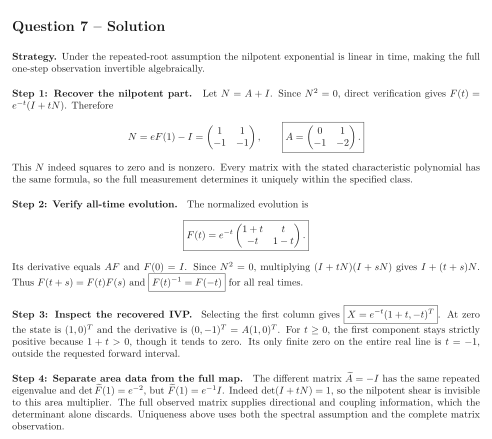
An unknown constant real matrix has characteristic polynomial . Its normalized evolution is measured exactly at one time: You may use the Cayley–Hamilton identity .
Tasks
Recover from the measured matrix and prove uniqueness under the stated spectral assumption.
Find for every real time and verify the evolution and inverse laws.
Solve the IVP . Does its first component cross zero for ?
Would measuring only recover the same matrix? Give a different admissible matrix and explain what information the full observation supplies.
Show solutionHide solution
Question 7 – Solution
Strategy. Under the repeated-root assumption the nilpotent exponential is linear in time, making the full one-step observation invertible algebraically.
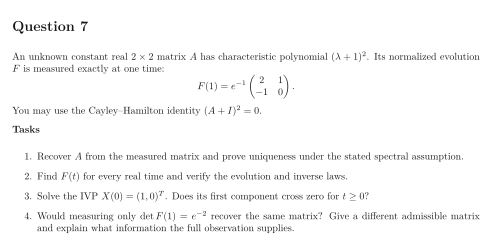
Step 1: Recover the nilpotent part. Let . Since , direct verification gives . Therefore This indeed squares to zero and is nonzero. Every matrix with the stated characteristic polynomial has the same formula, so the full measurement determines it uniquely within the specified class.
Step 2: Verify all-time evolution. The normalized evolution is Its derivative equals and . Since , multiplying gives . Thus and for all real times.
Step 3: Inspect the recovered IVP. Selecting the first column gives . At zero the state is and the derivative is . For , the first component stays strictly positive because , though it tends to zero. Its only finite zero on the entire real line is , outside the requested forward interval.
Step 4: Separate area data from the full map. The different matrix has the same repeated eigenvalue and , but . Indeed , so the nilpotent shear is invisible to this area multiplier. The full observed matrix supplies directional and coupling information, which the determinant alone discards. Uniqueness above uses both the spectral assumption and the complete matrix observation.