Question 9
The critically damped equation has a repeated negative characteristic root. A student claims that critical damping prevents the displacement from crossing its equilibrium for every choice of initial velocity.
Tasks
Write the equation as a state system with , find its eigenspace, and solve the stated IVP.
Classify exactly the values of for which crosses zero at a positive time. Give that time when it exists.
For the crossing case, find the subsequent minimum displacement and its time. For the other cases, describe forward monotonicity.
If the first displacement crossing is observed at a prescribed , recover the initial velocity. Explain why a single crossing does not imply oscillatory motion.
Show solutionHide solution
Question 9 – Solution
Strategy. The linear polynomial multiplying the repeated-root exponential determines whether the initial velocity produces an overshoot.
Step 1: Find the defective state solution. The state matrix is , with double eigenvalue and eigenspace . The initial data give These formulas verify , , and .
Step 2: Classify positive-time crossings. Because , a positive-time zero occurs exactly when . It is unique and equals . The polynomial has negative slope, so this is a crossing from positive to negative displacement. For , the displacement remains positive at every finite forward time. Thus critical damping alone does not prevent overshoot.
Step 3: Locate the minimum or prove monotonicity. If , changes from negative to positive at The displacement then increases toward zero from below. For , for all , so the positive displacement strictly decreases to zero; when , only the initial derivative vanishes.
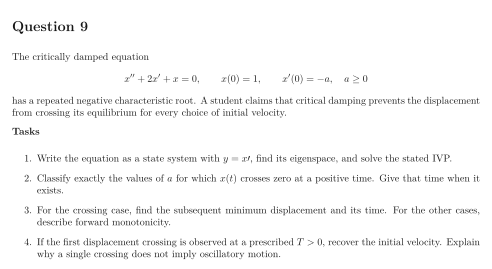
Step 4: Infer the velocity from the crossing. Solving gives . The solution has only one zero because its exponential factor never vanishes and its polynomial factor is linear. After the single minimum it approaches zero from below without further crossings. This is an initial-data-dependent overshoot, not a repeating oscillation. The time plot compares ; only the curve crosses in those examples.
See the diagram in the original worksheet below.