Question 6
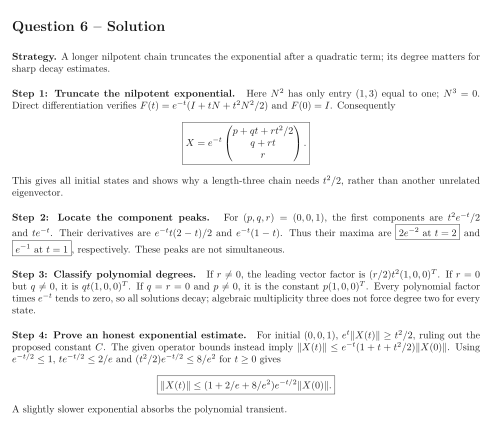
Let Use the Euclidean vector norm. For , the operator bounds and may be used.
Tasks
Compute the powers of needed to find the normalized evolution and the complete solution.
For initial , find the maximum of each of the first two components on and its time.
For arbitrary nonzero initial data, identify when the largest polynomial factor in the solution is quadratic, linear, or constant. Do all solutions decay?
Can one constant satisfy for all and all initial data? Prove instead a bound with decay and an explicit constant.
Show solutionHide solution
Question 6 – Solution
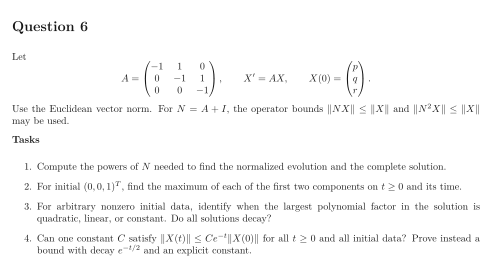
Strategy. A longer nilpotent chain truncates the exponential after a quadratic term; its degree matters for sharp decay estimates.
Step 1: Truncate the nilpotent exponential. Here has only entry equal to one; . Direct differentiation verifies and . Consequently This gives all initial states and shows why a length-three chain needs , rather than another unrelated eigenvector.
Step 2: Locate the component peaks. For , the first components are and . Their derivatives are and . Thus their maxima are and , respectively. These peaks are not simultaneous.
Step 3: Classify polynomial degrees. If , the leading vector factor is . If but , it is . If and , it is the constant . Every polynomial factor times tends to zero, so all solutions decay; algebraic multiplicity three does not force degree two for every state.
Step 4: Prove an honest exponential estimate. For initial , , ruling out the proposed constant . The given operator bounds instead imply . Using , and for gives A slightly slower exponential absorbs the polynomial transient.