Question 5
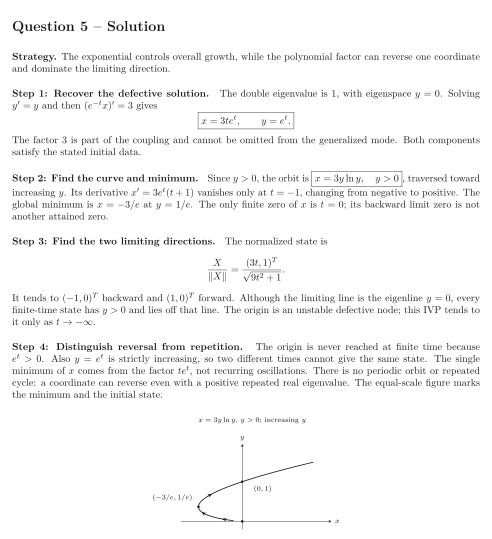
Let Examine the whole trajectory for , including its approach to the origin backward in time.
Tasks
Find the repeated eigenvalue and eigenspace, and solve the IVP.
Eliminate time and retain the full orbit domain. Find the unique minimum of and all its finite zeros.
Find the limiting normalized directions as and . Does approaching an eigenline imply that the trajectory lies on it?
Determine whether this orbit ever reaches the origin or repeats a state. Explain why its coordinate reversal is not an oscillation.
Show solutionHide solution
Question 5 – Solution
Strategy. The exponential controls overall growth, while the polynomial factor can reverse one coordinate and dominate the limiting direction.
Step 1: Recover the defective solution. The double eigenvalue is , with eigenspace . Solving and then gives The factor is part of the coupling and cannot be omitted from the generalized mode. Both components satisfy the stated initial data.
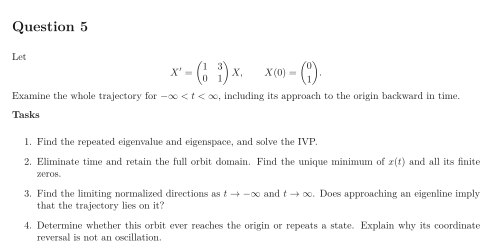
Step 2: Find the curve and minimum. Since , the orbit is , traversed toward increasing . Its derivative vanishes only at , changing from negative to positive. The global minimum is at . The only finite zero of is ; its backward limit zero is not another attained zero.
Step 3: Find the two limiting directions. The normalized state is It tends to backward and forward. Although the limiting line is the eigenline , every finite-time state has and lies off that line. The origin is an unstable defective node; this IVP tends to it only as .
Step 4: Distinguish reversal from repetition. The origin is never reached at finite time because . Also is strictly increasing, so two different times cannot give the same state. The single minimum of comes from the factor , not recurring oscillations. There is no periodic orbit or repeated cycle: a coordinate can reverse even with a positive repeated real eigenvalue. The equal-scale figure marks the minimum and the initial state.
See the diagram in the original worksheet below.