Question 3
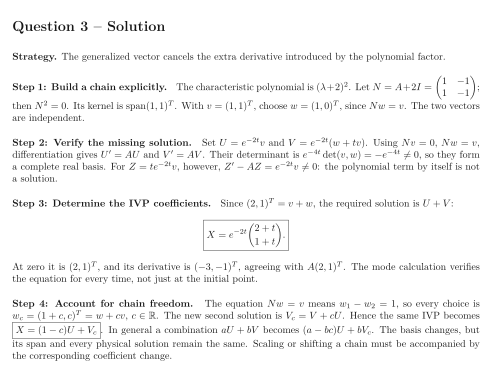
Consider For a repeated eigenvalue , a length-two chain means vectors with and .
Tasks
Find the eigenvalue, its eigenspace, and a chain with .
Derive and verify two independent real solutions using this chain. Explain why alone fails.
Solve the IVP and verify the initial state and derivative.
Find every generalized vector compatible with the fixed . Explain how changing changes the coefficients without changing the IVP solution.
Show solutionHide solution
Question 3 – Solution
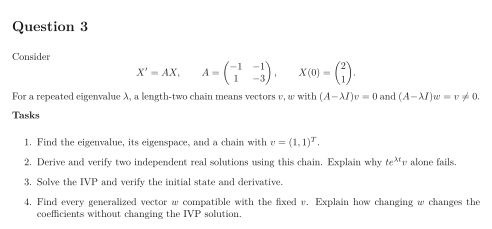
Strategy. The generalized vector cancels the extra derivative introduced by the polynomial factor.
Step 1: Build a chain explicitly. The characteristic polynomial is . Let ; then . Its kernel is . With , choose , since . The two vectors are independent.
Step 2: Verify the missing solution. Set and . Using , , differentiation gives and . Their determinant is , so they form a complete real basis. For , however, : the polynomial term by itself is not a solution.
Step 3: Determine the IVP coefficients. Since , the required solution is : At zero it is , and its derivative is , agreeing with . The mode calculation verifies the equation for every time, not just at the initial point.
Step 4: Account for chain freedom. The equation means , so every choice is , . The new second solution is . Hence the same IVP becomes . In general a combination becomes . The basis changes, but its span and every physical solution remain the same. Scaling or shifting a chain must be accompanied by the corresponding coefficient change.