Question 9
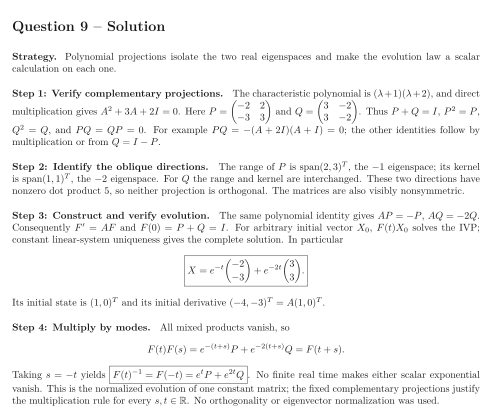
Let Here a projection means a matrix with ; it need not be an orthogonal projection. Develop a solution formula without choosing normalized eigenvectors.
Tasks
Find the eigenvalues and verify , , , and .
Identify the range and kernel of each projection. Are these projections orthogonal in the Euclidean plane?
Prove that satisfies and . Use it to solve the IVP .
Prove and find its inverse. Explain why these identities hold for every pair of real times here.
Show solutionHide solution
Question 9 – Solution
Strategy. Polynomial projections isolate the two real eigenspaces and make the evolution law a scalar calculation on each one.
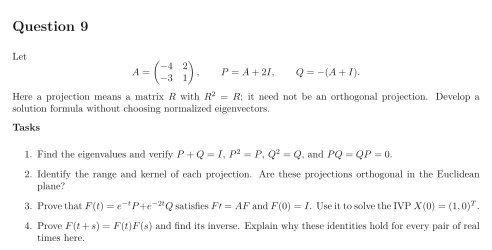
Step 1: Verify complementary projections. The characteristic polynomial is , and direct multiplication gives . Here and . Thus , , , and . For example ; the other identities follow by multiplication or from .
Step 2: Identify the oblique directions. The range of is , the eigenspace; its kernel is , the eigenspace. For the range and kernel are interchanged. These two directions have nonzero dot product , so neither projection is orthogonal. The matrices are also visibly nonsymmetric.
Step 3: Construct and verify evolution. The same polynomial identity gives , . Consequently and . For arbitrary initial vector , solves the IVP; constant linear-system uniqueness gives the complete solution. In particular Its initial state is and its initial derivative .
Step 4: Multiply by modes. All mixed products vanish, so Taking yields . No finite real time makes either scalar exponential vanish. This is the normalized evolution of one constant matrix; the fixed complementary projections justify the multiplication rule for every . No orthogonality or eigenvector normalization was used.