Question 7
Consider the damped nonlinear system with initial state . Define . A level curve of need not itself be a solution curve.
Tasks
Find the equilibrium and derive the exact change of along a solution.
Use the initial energy to prove bounds on both coordinates for every forward time. Explain why the smooth system then has a global forward solution.
At the initial state, . Does this mean that the solution is stationary or remains on its original energy level? Use the original equations to decide.
Prove that no nonconstant periodic orbit exists, by integrating the energy balance over a hypothetical period. Explain what the enclosing energy curve represents in the phase picture.
Show solutionHide solution
Question 7 – Solution
Strategy. A decreasing energy supplies a containing region and rules out a closed return without requiring an explicit trajectory.
Step 1: Compute the equilibrium and dissipation. Equilibrium requires and , hence only . Along solutions, Thus energy decreases except at instants when .
Step 2: Bound the forward solution. Initially . Since all energy terms are nonnegative, gives . Also , so and . Therefore The polynomial field is locally Lipschitz. These bounds keep the state in a compact region, preventing finite-time escape and allowing continuation for all forward times.
Step 3: Interpret zero instantaneous energy loss. At , the velocity is , not zero. Moreover for small positive , so becomes nonzero and . The solution enters lower energy levels. A horizontal zero of at one instant does not make energy constant on an interval or make its level curve a trajectory.
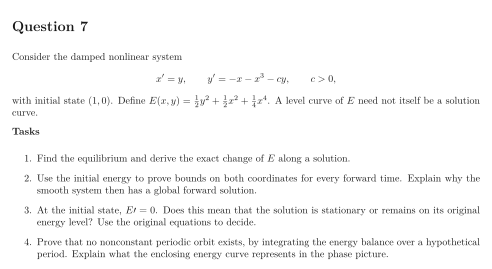
Step 4: Exclude nonconstant periodic motion. If a solution had period , integrating gives . Continuity and force , then and , so the solution is the zero equilibrium. Thus no nonconstant periodic orbit exists. The drawn curve bounds a forward-invariant region; it is not a closed orbit. Interior arrows show velocities for the illustrative choice .
See the diagram in the original worksheet below.