Question 6
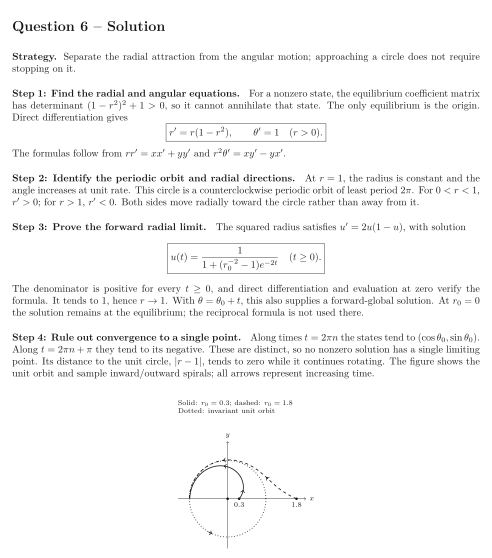
For , consider For , use polar coordinates with a continuously followed angle along each trajectory. A periodic orbit is a nonconstant closed trajectory.
Tasks
Find every equilibrium. Derive differential equations for and the angular coordinate.
Identify the invariant unit circle, its orientation and least positive period. Determine whether nearby trajectories move toward it from each side.
For any initial radius , solve the equation for and prove convergence to the unit circle in forward time. State separately what happens at .
Does a nonzero solution converge to one particular point on the unit circle? Prove your answer and distinguish approaching an orbit from approaching an equilibrium.
Show solutionHide solution
Question 6 – Solution
Strategy. Separate the radial attraction from the angular motion; approaching a circle does not require stopping on it.
Step 1: Find the radial and angular equations. For a nonzero state, the equilibrium coefficient matrix has determinant , so it cannot annihilate that state. The only equilibrium is the origin. Direct differentiation gives The formulas follow from and .
Step 2: Identify the periodic orbit and radial directions. At , the radius is constant and the angle increases at unit rate. This circle is a counterclockwise periodic orbit of least period . For , ; for , . Both sides move radially toward the circle rather than away from it.
Step 3: Prove the forward radial limit. The squared radius satisfies , with solution The denominator is positive for every , and direct differentiation and evaluation at zero verify the formula. It tends to , hence . With , this also supplies a forward-global solution. At the solution remains at the equilibrium; the reciprocal formula is not used there.
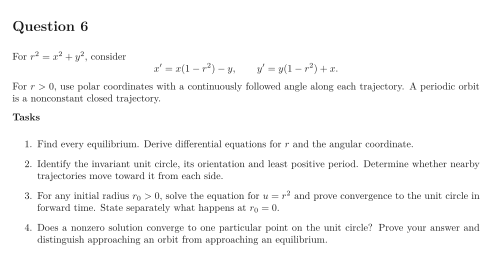
Step 4: Rule out convergence to a single point. Along times the states tend to . Along they tend to its negative. These are distinct, so no nonzero solution has a single limiting point. Its distance to the unit circle, , tends to zero while it continues rotating. The figure shows the unit orbit and sample inward/outward spirals; all arrows represent increasing time.
See the diagram in the original worksheet below.