Question 8
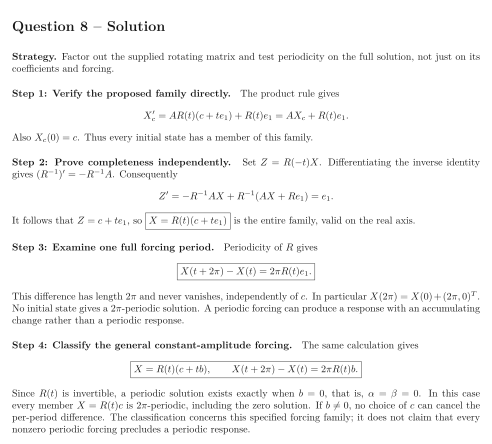
Let , and . Consider the periodically forced system You may use , and . A -periodic solution satisfies for all real .
Tasks
Verify that is a solution for every constant vector . Determine its initial state.
Prove that this family contains every solution, by differentiating .
Compute the change in state over one forcing period and decide whether any choice of initial data produces a -periodic solution.
Replace in the forcing by an arbitrary constant vector . Find the full solution family and classify exactly when a -periodic solution exists.
Show solutionHide solution
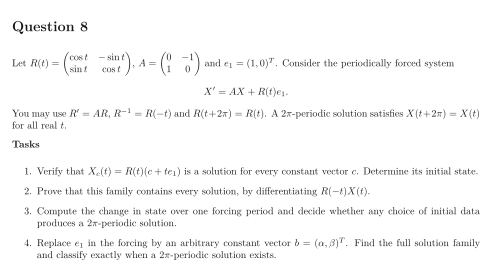
Question 8 – Solution
Strategy. Factor out the supplied rotating matrix and test periodicity on the full solution, not just on its coefficients and forcing.
Step 1: Verify the proposed family directly. The product rule gives Also . Thus every initial state has a member of this family.
Step 2: Prove completeness independently. Set . Differentiating the inverse identity gives . Consequently It follows that , so is the entire family, valid on the real axis.
Step 3: Examine one full forcing period. Periodicity of gives This difference has length and never vanishes, independently of . In particular . No initial state gives a -periodic solution. A periodic forcing can produce a response with an accumulating change rather than a periodic response.
Step 4: Classify the general constant-amplitude forcing. The same calculation gives Since is invertible, a periodic solution exists exactly when , that is, . In this case every member is -periodic, including the zero solution. If , no choice of can cancel the per-period difference. The classification concerns this specified forcing family; it does not claim that every nonzero periodic forcing precludes a periodic response.