Question 2
Let and A principal fundamental matrix at is a fundamental matrix satisfying . For real , also define and .
Tasks
Verify and calculate its determinant. Explain why its columns describe a complete homogeneous solution family.
Construct the principal fundamental matrix and verify . Express its entries using hyperbolic functions or exponentials.
For arbitrary initial data , find the constants in and the same solution in the form .
Classify when is a fundamental matrix. At and , determine exactly which initial states can still be represented by , even though every column remains a solution.
Show solutionHide solution
Question 2 – Solution
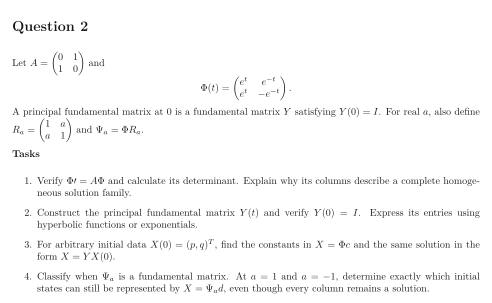
Strategy. Distinguish solution columns from a complete basis, and normalize by the matrix at the initial time.
Step 1: Verify the columns and independence. Differentiating each exponential column gives . Its determinant is , never zero. Every initial vector can therefore be represented by ; uniqueness of the linear IVP proves that the resulting constant combination supplies every solution.
Step 2: Normalize at the initial time. Since , Here , . Thus and by differentiation or constant right multiplication.
Step 3: Recover arbitrary data. Solving gives This equals . The constants in a nonnormalized basis are not generally the initial state coordinates themselves.
Step 4: Detect a collapsed family. Constant combinations remain solutions, but , so the family is fundamental exactly when . At , both columns are , whose value at is ; exactly the initial states are representable. At , the columns are and its negative, with initial value ; exactly are representable. Here denote the columns of . Neither singular case supplies all initial states, despite having two displayed solution columns.