Question 1
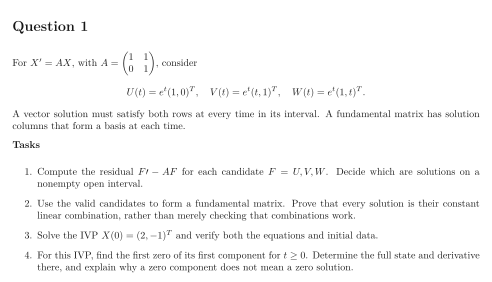
For , with , consider A vector solution must satisfy both rows at every time in its interval. A fundamental matrix has solution columns that form a basis at each time.
Tasks
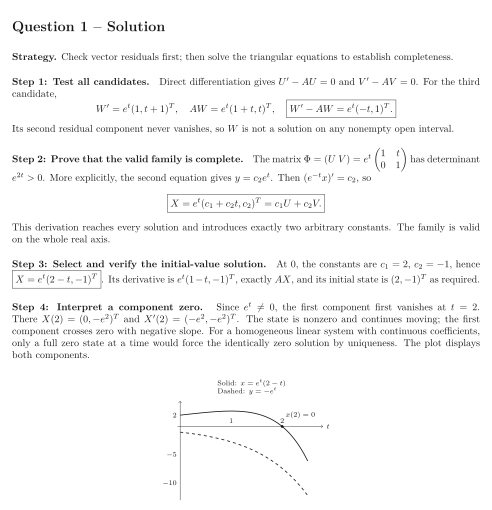
Compute the residual for each candidate . Decide which are solutions on a nonempty open interval.
Use the valid candidates to form a fundamental matrix. Prove that every solution is their constant linear combination, rather than merely checking that combinations work.
Solve the IVP and verify both the equations and initial data.
For this IVP, find the first zero of its first component for . Determine the full state and derivative there, and explain why a zero component does not mean a zero solution.
Show solutionHide solution
Question 1 – Solution
Strategy. Check vector residuals first; then solve the triangular equations to establish completeness.
Step 1: Test all candidates. Direct differentiation gives and . For the third candidate, Its second residual component never vanishes, so is not a solution on any nonempty open interval.
Step 2: Prove that the valid family is complete. The matrix has determinant . More explicitly, the second equation gives . Then , so This derivation reaches every solution and introduces exactly two arbitrary constants. The family is valid on the whole real axis.
Step 3: Select and verify the initial-value solution. At , the constants are , , hence . Its derivative is , exactly , and its initial state is as required.
Step 4: Interpret a component zero. Since , the first component first vanishes at . There and . The state is nonzero and continues moving; the first component crosses zero with negative slope. For a homogeneous linear system with continuous coefficients, only a full zero state at a time would force the identically zero solution by uniqueness. The plot displays both components.
See the diagram in the original worksheet below.