Question 2
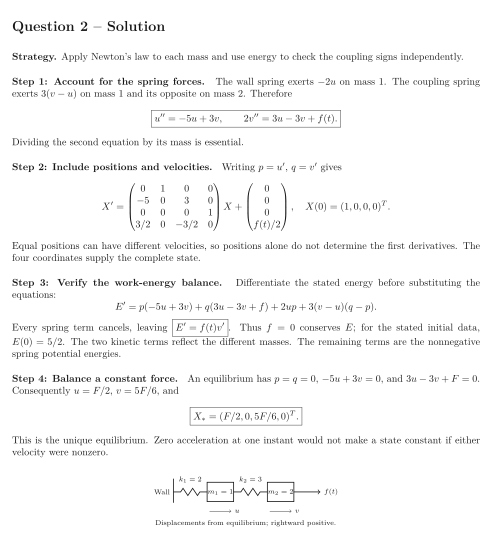
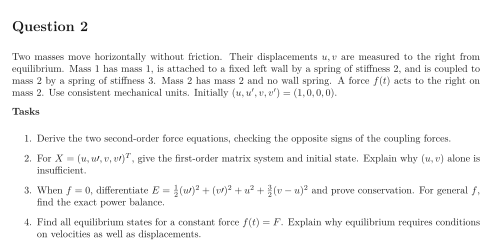
Two masses move horizontally without friction. Their displacements are measured to the right from equilibrium. Mass has mass , is attached to a fixed left wall by a spring of stiffness , and is coupled to mass by a spring of stiffness . Mass has mass and no wall spring. A force acts to the right on mass . Use consistent mechanical units. Initially .
Tasks
Derive the two second-order force equations, checking the opposite signs of the coupling forces.
For , give the first-order matrix system and initial state. Explain why alone is insufficient.
When , differentiate and prove conservation. For general , find the exact power balance.
Find all equilibrium states for a constant force . Explain why equilibrium requires conditions on velocities as well as displacements.
Show solutionHide solution
Question 2 – Solution
Strategy. Apply Newton’s law to each mass and use energy to check the coupling signs independently.
Step 1: Account for the spring forces. The wall spring exerts on mass . The coupling spring exerts on mass and its opposite on mass . Therefore Dividing the second equation by its mass is essential.
Step 2: Include positions and velocities. Writing , gives Equal positions can have different velocities, so positions alone do not determine the first derivatives. The four coordinates supply the complete state.
Step 3: Verify the work-energy balance. Differentiate the stated energy before substituting the equations: Every spring term cancels, leaving . Thus conserves ; for the stated initial data, . The two kinetic terms reflect the different masses. The remaining terms are the nonnegative spring potential energies.
Step 4: Balance a constant force. An equilibrium has , , and . Consequently , , and This is the unique equilibrium. Zero acceleration at one instant would not make a state constant if either velocity were nonzero.
See the diagram in the original worksheet below.