Question 3
Two perfectly mixed tanks have constant volumes L and L. Fresh water enters tank at L/min. Tank sends L/min to tank ; tank returns L/min to tank and drains L/min outside. Let be the salt amounts in grams, with , . You may use the inward-boundary criterion: for a locally Lipschitz vector field, the nonnegative quadrant is forward invariant if its boundary derivatives point inward or are tangent.
Tasks
Check both volume balances and derive the first-order system for salt amounts. Identify the concentration used in each outflow term.
Write the amount system in matrix form. Then derive the system for concentrations , , including initial data.
Find the derivative of total salt and explain why the internal transfer rates cancel even though the volumes differ. Find every equilibrium.
Prove that nonnegative initial amounts remain nonnegative and that total salt cannot increase. Give explicit bounds for this initial state without solving the coupled system.
Show solutionHide solution
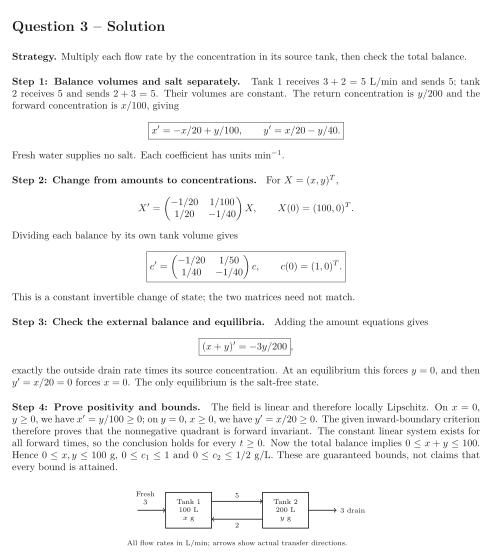
Question 3 – Solution
Strategy. Multiply each flow rate by the concentration in its source tank, then check the total balance.
Step 1: Balance volumes and salt separately. Tank receives L/min and sends ; tank receives and sends . Their volumes are constant. The return concentration is and the forward concentration is , giving Fresh water supplies no salt. Each coefficient has units min.
Step 2: Change from amounts to concentrations. For , Dividing each balance by its own tank volume gives This is a constant invertible change of state; the two matrices need not match.
Step 3: Check the external balance and equilibria. Adding the amount equations gives exactly the outside drain rate times its source concentration. At an equilibrium this forces , and then forces . The only equilibrium is the salt-free state.
Step 4: Prove positivity and bounds. The field is linear and therefore locally Lipschitz. On , , we have ; on , , we have . The given inward-boundary criterion therefore proves that the nonnegative quadrant is forward invariant. The constant linear system exists for all forward times, so the conclusion holds for every . Now the total balance implies . Hence g, and g/L. These are guaranteed bounds, not claims that every bound is attained.
See the diagram in the original worksheet below.