Question 8
For , let A student evaluates and and declares these the limiting state for every . For rational transforms, the final-value theorem requires all poles of the simplified to have negative real part.
Tasks
Find both transformed components for general and calculate the student’s two proposed limits.
Solve the case . Check the theorem’s hypothesis and determine whether either component has a limit as .
For , invert the transforms and establish the true limiting state. Explain why the theorem now applies.
Show that at each fixed time as but not uniformly on . Use times to obtain a lower bound on the uniform error. Sketch and .
Show solutionHide solution
Question 8 – Solution
Strategy. Check pole locations before applying the final-value theorem, and distinguish fixed-time convergence from an infinite-time assertion.
Step 1: Solve the transformed system. With , the equations give A sufficient convergence half-plane is . The proposed final values are and .
Step 2: Examine the undamped case. At , inversion yields . Neither has a limit: the values along successive maxima and minima differ. Both and have poles at , so the stated theorem’s hypothesis fails. The finite algebraic values and do not prove convergence in time.
Step 3: Resolve the damped response. For , decompose, for example, Inverting this and the analogous decomposition of gives Both start at zero. The exponentially decaying terms leave the limit . Now the poles of and are , strictly in the left half-plane, as required. The limit also solves the equilibrium equations.
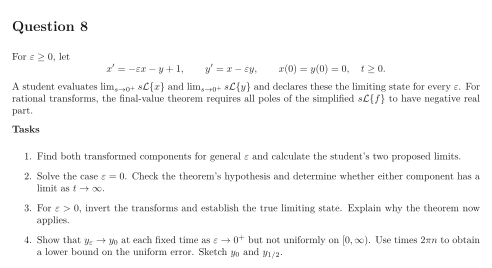
Step 4: Test uniformity on the whole half-line. At fixed , the formula gives . But , whereas . Consequently This lower bound tends to , not . Fixed-time convergence therefore cannot be used to pass a limiting-state conclusion to the undamped system. The dotted guide is the damped limit for .
See the diagram in the original worksheet below.