Question 7
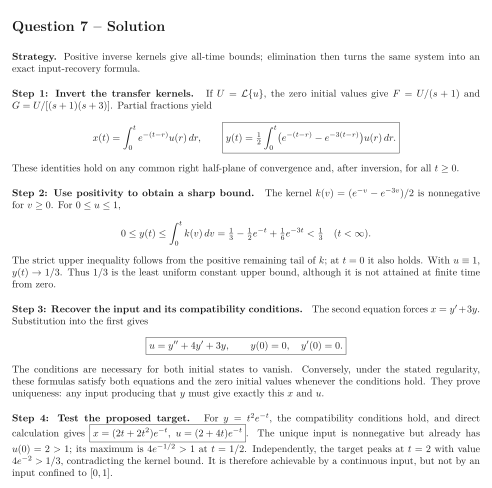
A scalar input drives a two-stage system: Assume is continuous and of exponential order. In the inverse task, assume a prescribed target and its first two derivatives are continuous and of exponential order. All claims about input bounds apply for every .
Tasks
Derive both transfer expressions in the Laplace domain and invert their kernels to express and as convolutions with .
If , prove a sharp constant upper bound on . Explain in what sense the bound is sharp.
Recover and from a prescribed . State the initial compatibility conditions and justify uniqueness of the recovered input.
Apply the inverse formula to . Find , decide whether is possible, and give a second obstruction using the target’s maximum.
Show solutionHide solution
Question 7 – Solution
Strategy. Positive inverse kernels give all-time bounds; elimination then turns the same system into an exact input-recovery formula.
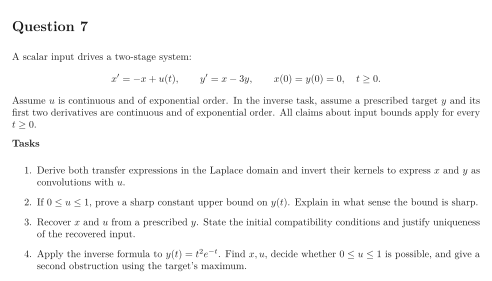
Step 1: Invert the transfer kernels. If , the zero initial values give and . Partial fractions yield These identities hold on any common right half-plane of convergence and, after inversion, for all .
Step 2: Use positivity to obtain a sharp bound. The kernel is nonnegative for . For , The strict upper inequality follows from the positive remaining tail of ; at it also holds. With , . Thus is the least uniform constant upper bound, although it is not attained at finite time from zero.
Step 3: Recover the input and its compatibility conditions. The second equation forces . Substitution into the first gives The conditions are necessary for both initial states to vanish. Conversely, under the stated regularity, these formulas satisfy both equations and the zero initial values whenever the conditions hold. They prove uniqueness: any input producing that must give exactly this and .
Step 4: Test the proposed target. For , the compatibility conditions hold, and direct calculation gives . The unique input is nonnegative but already has ; its maximum is at . Independently, the target peaks at with value , contradicting the kernel bound. It is therefore achievable by a continuous input, but not by an input confined to .