Question 6
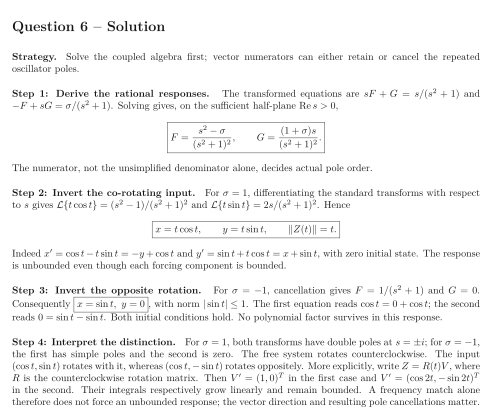
Two inputs with the same frequency drive the same system from rest: Use Laplace transforms to investigate why a frequency match alone does not settle whether this vector input generates growing oscillations.
Tasks
Derive both transformed components for general , showing the denominator before any cancellation.
For , invert the transforms and verify the original equations. Determine the Euclidean norm for .
For , simplify before inversion, solve the IVP and prove boundedness.
Compare the pole orders and the input directions in the two cases. Is every sinusoidal vector forcing at the natural frequency resonant in the sense of an unbounded zero-state response?
Show solutionHide solution
Question 6 – Solution
Strategy. Solve the coupled algebra first; vector numerators can either retain or cancel the repeated oscillator poles.
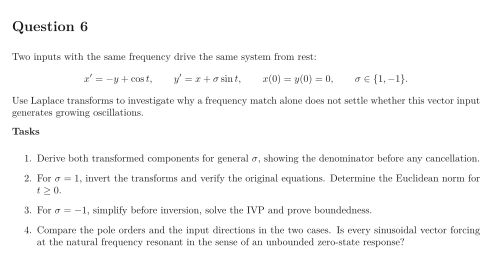
Step 1: Derive the rational responses. The transformed equations are and . Solving gives, on the sufficient half-plane , The numerator, not the unsimplified denominator alone, decides actual pole order.
Step 2: Invert the co-rotating input. For , differentiating the standard transforms with respect to gives and . Hence Indeed and , with zero initial state. The response is unbounded even though each forcing component is bounded.
Step 3: Invert the opposite rotation. For , cancellation gives and . Consequently , with norm . The first equation reads ; the second reads . Both initial conditions hold. No polynomial factor survives in this response.
Step 4: Interpret the distinction. For , both transforms have double poles at ; for , the first has simple poles and the second is zero. The free system rotates counterclockwise. The input rotates with it, whereas rotates oppositely. More explicitly, write , where is the counterclockwise rotation matrix. Then in the first case and in the second. Their integrals respectively grow linearly and remain bounded. A frequency match alone therefore does not force an unbounded response; the vector direction and resulting pole cancellations matter.