Question 9
Consider the input-driven system Choose an input so that . First restrict attention to inputs of the form .
Tasks
Express the endpoint conditions as two integral conditions on a general continuous input .
Find the unique affine input satisfying both conditions. Explain why a constant input cannot work.
Compute the entire state path for that input. Determine whether displacement is monotone and find the maximum velocity.
Is the input unique among all continuous functions? Test additions of , with arbitrary real , and distinguish endpoint agreement from identical intermediate motion.
Show solutionHide solution
Question 9 – Solution
Strategy. The endpoint conditions constrain two weighted integrals of the input, not all of its time-dependent values.
Step 1: Derive the two input moments. Integrating gives . A second integration yields , verified by differentiation and the zero initial data. The endpoint requirements are
Step 2: Solve within the affine family. For , these conditions become and . Their unique solution is , so . A constant input would need from the final velocity condition, then could not create displacement one.
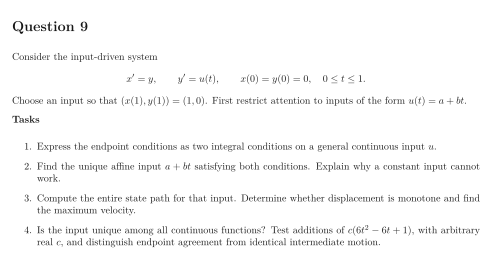
Step 3: Recover and interpret the state path. Integration gives The state starts at zero and ends at . Since for , displacement strictly increases through the interior. Velocity has its unique maximum at , where the input changes sign. The negative input in the second half slows the positive velocity to zero; it does not reverse the displacement.
Step 4: Expose the remaining freedom. Let . Direct integration gives and , hence also . Therefore every reaches the same endpoint. For , is not identically zero, so the velocity derivative and intermediate motion differ. Uniqueness holds within the affine trial family, not among all continuous inputs. No monotonicity claim is made for the added-input family.
See the diagram in the original worksheet below.