Question 8
For , let where for and for . Take the state to be continuous at the switch; use one-sided derivatives there. The value assigned to does not change the continuous solution.
Tasks
Solve on , then continue for using and the state at the switch.
Find the one-sided state derivatives at . Which component derivative is continuous, and which jumps?
Find the global forward maximum of and its time. Explain why the maximum occurs after the input has switched off.
Find the long-time limit and the integrals and by integrating the differential equations.
Show solutionHide solution
Question 8 – Solution
Strategy. Match the state at the switch, then track the stored second-component response as it continues to feed the first.
Step 1: Solve and match the two intervals. For , integration gives , . Set , , the switch values. For , the homogeneous continuation is At these match the first formulas, so both components are continuous.
Step 2: Compare one-sided derivatives. Before the switch, . Thus . Immediately after it, . The derivative is continuous; has jump . A finite step input changes a derivative, not the state itself.
Step 3: Find the delayed first-component peak. Before switching, for . Afterward, , with . It changes sign once, at , hence The still-positive initially exceeds after the input ends, so remains positive until the two components become equal.
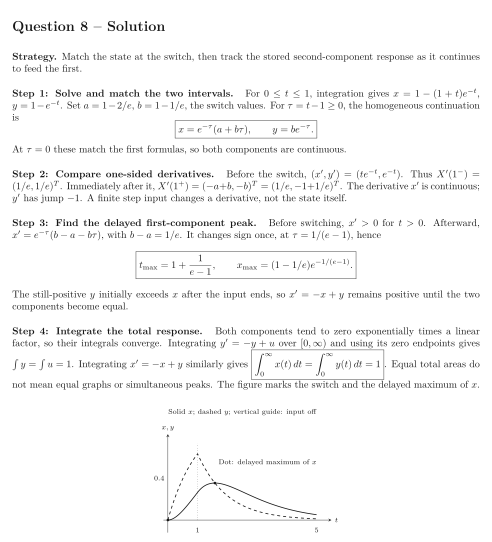
Step 4: Integrate the total response. Both components tend to zero exponentially times a linear factor, so their integrals converge. Integrating over and using its zero endpoints gives . Integrating similarly gives . Equal total areas do not mean equal graphs or simultaneous peaks. The figure marks the switch and the delayed maximum of .
See the diagram in the original worksheet below.