Question 7
Work over the real numbers. Use substitution or elimination, keeping track of conditions under which an operation preserves all solutions. Check candidates in the original equations.
A sensor’s response is assumed to be a quadratic polynomial . Exact readings at three times are Later, consider a perturbation of only the last reading to , where and .
Tasks
Find the unique polynomial from the exact readings using a system of equations. Predict .
Find the exact perturbed coefficients and the response error at an arbitrary time .
Identify all nonnegative times whose predicted value is insensitive to this perturbation. Find sharp uniform error bounds on and at .
Explain which conclusions depend on the quadratic model. Construct a nonquadratic smooth response with the same three original readings but a different value at .
Show solutionHide solution
Question 7 – Solution
Strategy. A model assumption converts function recovery into coefficient recovery, while extrapolation can amplify measurement errors.
Step 1: Solve the exact coefficient equations. The data give , and . Thus and , yielding and . Every coefficient is forced, so
Step 2: Retain the measurement perturbation. The first two equations are unchanged, while . Solving gives The error vanishes at both unchanged measurement times and equals at , as required.
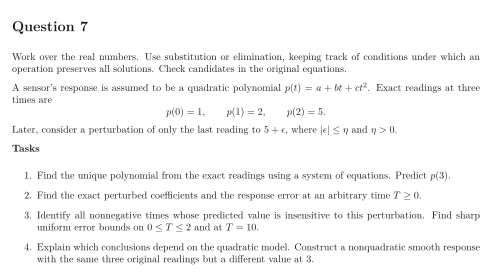
Step 3: Compare interpolation and extrapolation. The error is independent of exactly when , so the nonnegative insensitive times are and . On , ; on , increases from to . Therefore Both bounds are sharp at , the first at . The figure shows the true curves for .
Step 4: State the model’s limitation. For any real , the smooth function matches all three original readings. For it is not quadratic, and . Thus three readings uniquely determine a member of the quadratic family, not an arbitrary smooth response. Extrapolation bounds also rely on the quadratic family and on the stated location of the measurement error.
See the diagram in the original worksheet below.