Question 6
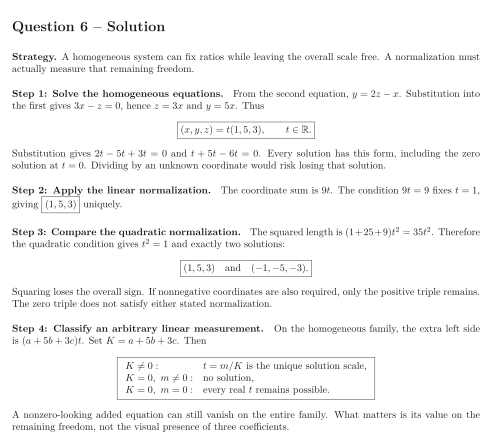
Work over the real numbers. Use substitution or elimination, keeping track of conditions under which an operation preserves all solutions. Check candidates in the original equations.
A homogeneous system is Two proposed ways to choose a scale are and . These are alternative added conditions, not simultaneous unless explicitly stated.
Tasks
Find and verify the entire solution set of the homogeneous system, explaining the role of the zero solution.
Apply the linear normalization and determine whether it selects a unique solution.
Apply the quadratic normalization instead. Explain its sign ambiguity and resolve it if nonnegative coordinates are additionally required.
For arbitrary real , classify the effect of adding : give exact conditions for no solution, one solution or infinitely many solutions.
Show solutionHide solution
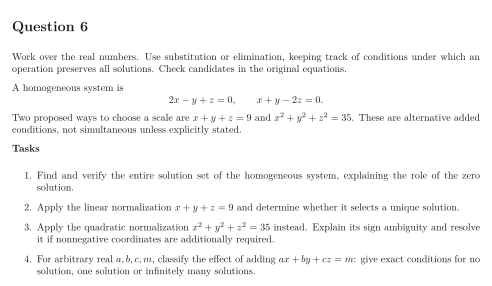
Question 6 – Solution
Strategy. A homogeneous system can fix ratios while leaving the overall scale free. A normalization must actually measure that remaining freedom.
Step 1: Solve the homogeneous equations. From the second equation, . Substitution into the first gives , hence and . Thus Substitution gives and . Every solution has this form, including the zero solution at . Dividing by an unknown coordinate would risk losing that solution.
Step 2: Apply the linear normalization. The coordinate sum is . The condition fixes , giving uniquely.
Step 3: Compare the quadratic normalization. The squared length is . Therefore the quadratic condition gives and exactly two solutions: Squaring loses the overall sign. If nonnegative coordinates are also required, only the positive triple remains. The zero triple does not satisfy either stated normalization.
Step 4: Classify an arbitrary linear measurement. On the homogeneous family, the extra left side is . Set . Then A nonzero-looking added equation can still vanish on the entire family. What matters is its value on the remaining freedom, not the visual presence of three coefficients.