Question 5
Work over the real numbers. Use substitution or elimination, keeping track of conditions under which an operation preserves all solutions. Check candidates in the original equations.
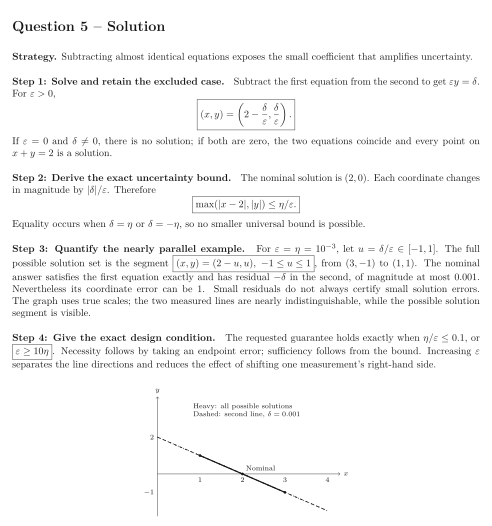
Two nearly parallel measurement equations are where is known and is an unknown measurement error satisfying , with .
Tasks
Find the exact solution for every admissible and explain what would happen if were allowed.
Find the smallest uniform bound on the largest absolute coordinate error relative to the nominal solution at . Prove sharpness.
For , find the full range of possible solutions. Compare the small equation residual of the nominal answer with its possible coordinate error.
Find a necessary and sufficient condition on ensuring both coordinate errors are at most for every . Interpret the condition geometrically.
Show solutionHide solution
Question 5 – Solution
Strategy. Subtracting almost identical equations exposes the small coefficient that amplifies uncertainty.
Step 1: Solve and retain the excluded case. Subtract the first equation from the second to get . For , If and , there is no solution; if both are zero, the two equations coincide and every point on is a solution.
Step 2: Derive the exact uncertainty bound. The nominal solution is . Each coordinate changes in magnitude by . Therefore Equality occurs when or , so no smaller universal bound is possible.
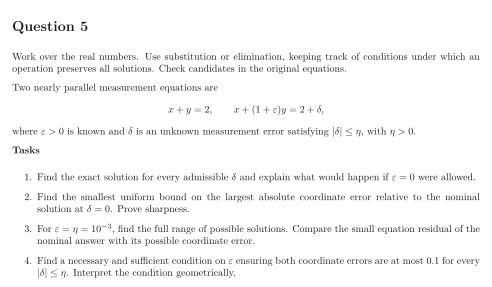
Step 3: Quantify the nearly parallel example. For , let . The full possible solution set is the segment , from to . The nominal answer satisfies the first equation exactly and has residual in the second, of magnitude at most . Nevertheless its coordinate error can be . Small residuals do not always certify small solution errors. The graph uses true scales; the two measured lines are nearly indistinguishable, while the possible solution segment is visible.
Step 4: Give the exact design condition. The requested guarantee holds exactly when , or . Necessity follows by taking an endpoint error; sufficiency follows from the bound. Increasing separates the line directions and reduces the effect of shifting one measurement’s right-hand side.
See the diagram in the original worksheet below.