Question 4
Work over the real numbers. Use substitution or elimination, keeping track of conditions under which an operation preserves all solutions. Check candidates in the original equations.
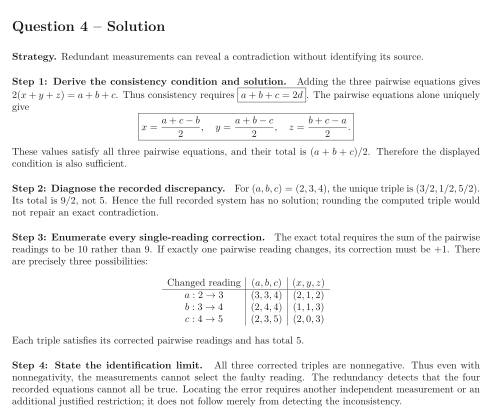
Three unknown quantities are measured through pairwise sums and a total: The recorded values are .
Tasks
Derive a necessary and sufficient condition on arbitrary real for consistency. Give the unique solution when it exists.
For the recorded data, solve the first three equations and identify the conflict with the fourth.
Assume the total is exact and exactly one of the three pairwise readings is wrong. Find every possible corrected reading and corresponding triple .
Decide whether these measurements identify which pairwise reading is wrong, even if must be nonnegative. Explain the difference between detecting an error and locating it.
Show solutionHide solution
Question 4 – Solution
Strategy. Redundant measurements can reveal a contradiction without identifying its source.
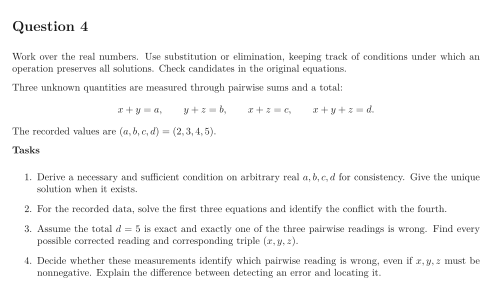
Step 1: Derive the consistency condition and solution. Adding the three pairwise equations gives . Thus consistency requires . The pairwise equations alone uniquely give These values satisfy all three pairwise equations, and their total is . Therefore the displayed condition is also sufficient.
Step 2: Diagnose the recorded discrepancy. For , the unique triple is . Its total is , not . Hence the full recorded system has no solution; rounding the computed triple would not repair an exact contradiction.
Step 3: Enumerate every single-reading correction. The exact total requires the sum of the pairwise readings to be rather than . If exactly one pairwise reading changes, its correction must be . There are precisely three possibilities: Each triple satisfies its corrected pairwise readings and has total .
Step 4: State the identification limit. All three corrected triples are nonnegative. Thus even with nonnegativity, the measurements cannot select the faulty reading. The redundancy detects that the four recorded equations cannot all be true. Locating the error requires another independent measurement or an additional justified restriction; it does not follow merely from detecting the inconsistency.