Question 3
Work over the real numbers. Use substitution or elimination, keeping track of conditions under which an operation preserves all solutions. Check candidates in the original equations.
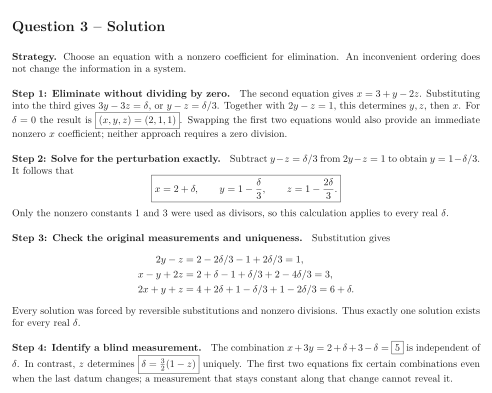
A system begins with an equation whose coefficient is zero: where is a real perturbation of the last measurement.
Tasks
Solve the system for using valid elimination. Explain why the initial zero coefficient is not evidence of nonuniqueness.
Find the exact solution for arbitrary , keeping fractions exact.
Verify the perturbed solution in all original equations, and decide whether any makes the system inconsistent or nonunique.
Compute and recover from an exact measurement of . Explain why measuring alone cannot detect the perturbation.
Show solutionHide solution
Question 3 – Solution
Strategy. Choose an equation with a nonzero coefficient for elimination. An inconvenient ordering does not change the information in a system.
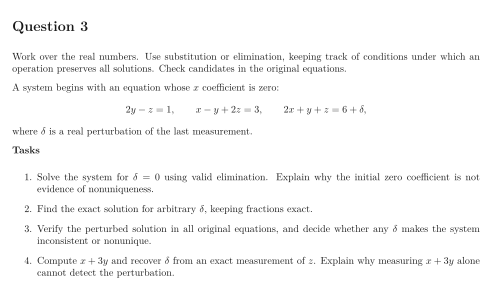
Step 1: Eliminate without dividing by zero. The second equation gives . Substituting into the third gives , or . Together with , this determines , then . For the result is . Swapping the first two equations would also provide an immediate nonzero coefficient; neither approach requires a zero division.
Step 2: Solve for the perturbation exactly. Subtract from to obtain . It follows that Only the nonzero constants and were used as divisors, so this calculation applies to every real .
Step 3: Check the original measurements and uniqueness. Substitution gives Every solution was forced by reversible substitutions and nonzero divisions. Thus exactly one solution exists for every real .
Step 4: Identify a blind measurement. The combination is independent of . In contrast, determines uniquely. The first two equations fix certain combinations even when the last datum changes; a measurement that stays constant along that change cannot reveal it.