Question 8
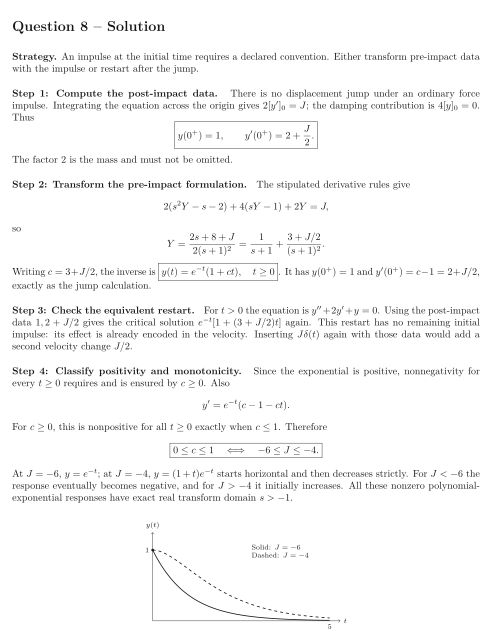
Interpret the equation through ordinary motion away from the impulse and its jump conditions. For this question only, the initial-time transform convention is specified below; write for a jump.
Use a full-mass initial impulse convention: the transform starts at , , and Consider These are pre-impact data, not post-impact data.
Tasks
Find and by the impulse jump conditions.
Use the stated convention to find and the response for .
Reproduce the same response by solving a regular homogeneous IVP from . Explain why keeping the impulse again would double-count it.
Classify every for which the post-impact response is nonnegative and nonincreasing for all . Describe the boundary cases.
Show solutionHide solution
Question 8 – Solution
Strategy. An impulse at the initial time requires a declared convention. Either transform pre-impact data with the impulse or restart after the jump.
Step 1: Compute the post-impact data. There is no displacement jump under an ordinary force impulse. Integrating the equation across the origin gives ; the damping contribution is . Thus The factor is the mass and must not be omitted.
Step 2: Transform the pre-impact formulation. The stipulated derivative rules give so Writing , the inverse is . It has and , exactly as the jump calculation.
Step 3: Check the equivalent restart. For the equation is . Using the post-impact data gives the critical solution again. This restart has no remaining initial impulse: its effect is already encoded in the velocity. Inserting again with those data would add a second velocity change .
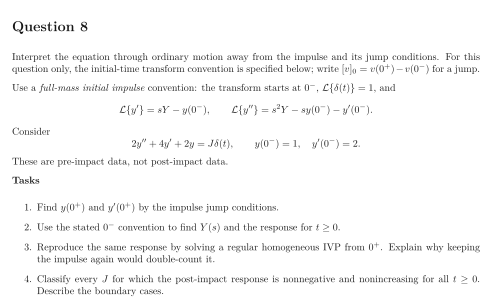
Step 4: Classify positivity and monotonicity. Since the exponential is positive, nonnegativity for every requires and is ensured by . Also For , this is nonpositive for all exactly when . Therefore At , ; at , starts horizontal and then decreases strictly. For the response eventually becomes negative, and for it initially increases. All these nonzero polynomial-exponential responses have exact real transform domain .
See the diagram in the original worksheet below.