Question 6
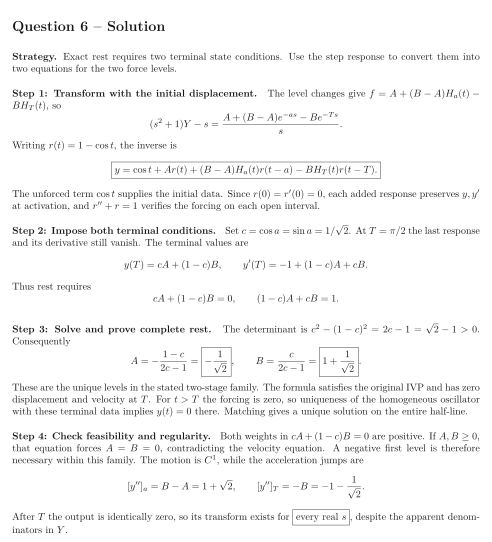
Let for and for . Use one-sided Laplace transforms. Solutions are continuous (and have continuous first derivative for second-order equations); satisfy the equation away from switches and use one-sided derivatives there. Isolated input values do not change the solution.
Choose two constant force levels to bring an oscillator exactly to rest: Require for every . The levels may have either sign.
Tasks
Express using steps and derive , including the initial response.
Invert and derive the two linear equations that the terminal conditions impose on .
Solve for both force levels and prove that they give a unique motion which remains at rest after .
Decide whether nonnegative levels could meet the target. Describe the smoothness at both switches and the exact real transform domain of the designed output.
Show solutionHide solution
Question 6 – Solution
Strategy. Exact rest requires two terminal state conditions. Use the step response to convert them into two equations for the two force levels.
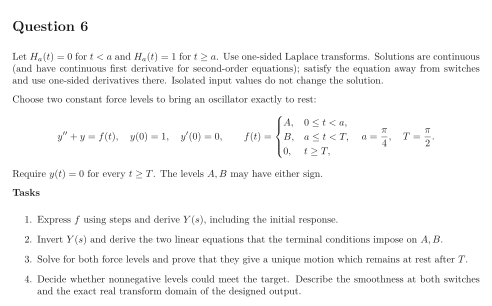
Step 1: Transform with the initial displacement. The level changes give , so Writing , the inverse is The unforced term supplies the initial data. Since , each added response preserves at activation, and verifies the forcing on each open interval.
Step 2: Impose both terminal conditions. Set . At the last response and its derivative still vanish. The terminal values are Thus rest requires
Step 3: Solve and prove complete rest. The determinant is . Consequently These are the unique levels in the stated two-stage family. The formula satisfies the original IVP and has zero displacement and velocity at . For the forcing is zero, so uniqueness of the homogeneous oscillator with these terminal data implies there. Matching gives a unique solution on the entire half-line.
Step 4: Check feasibility and regularity. Both weights in are positive. If , that equation forces , contradicting the velocity equation. A negative first level is therefore necessary within this family. The motion is , while the acceleration jumps are After the output is identically zero, so its transform exists for , despite the apparent denominators in .