Question 5
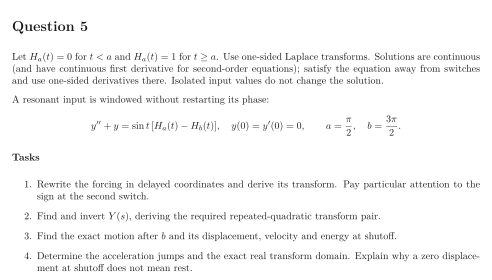
Let for and for . Use one-sided Laplace transforms. Solutions are continuous (and have continuous first derivative for second-order equations); satisfy the equation away from switches and use one-sided derivatives there. Isolated input values do not change the solution.
A resonant input is windowed without restarting its phase:
Tasks
Rewrite the forcing in delayed coordinates and derive its transform. Pay particular attention to the sign at the second switch.
Find and invert , deriving the required repeated-quadratic transform pair.
Find the exact motion after and its displacement, velocity and energy at shutoff.
Determine the acceleration jumps and the exact real transform domain. Explain why a zero displacement at shutoff does not mean rest.
Show solutionHide solution
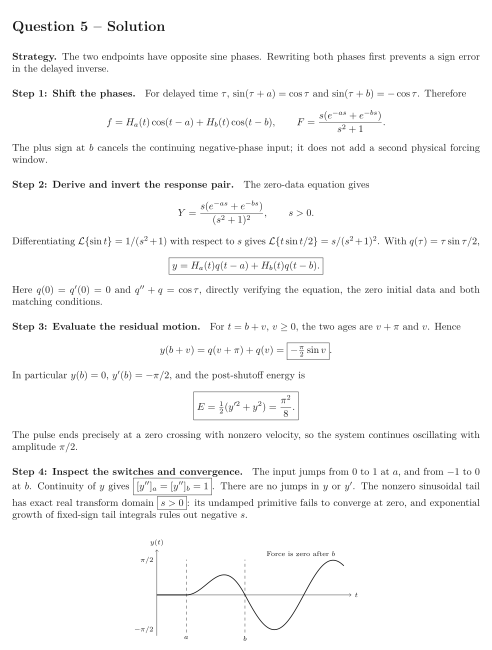
Question 5 – Solution
Strategy. The two endpoints have opposite sine phases. Rewriting both phases first prevents a sign error in the delayed inverse.
Step 1: Shift the phases. For delayed time , and . Therefore The plus sign at cancels the continuing negative-phase input; it does not add a second physical forcing window.
Step 2: Derive and invert the response pair. The zero-data equation gives Differentiating with respect to gives . With , Here and , directly verifying the equation, the zero initial data and both matching conditions.
Step 3: Evaluate the residual motion. For , , the two ages are and . Hence In particular , , and the post-shutoff energy is The pulse ends precisely at a zero crossing with nonzero velocity, so the system continues oscillating with amplitude .
Step 4: Inspect the switches and convergence. The input jumps from to at , and from to at . Continuity of gives . There are no jumps in or . The nonzero sinusoidal tail has exact real transform domain : its undamped primitive fails to converge at zero, and exponential growth of fixed-sign tail integrals rules out negative .
See the diagram in the original worksheet below.