Question 7
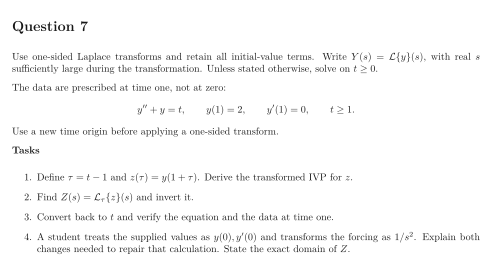
Use one-sided Laplace transforms and retain all initial-value terms. Write , with real sufficiently large during the transformation. Unless stated otherwise, solve on .
The data are prescribed at time one, not at zero: Use a new time origin before applying a one-sided transform.
Tasks
Define and . Derive the transformed IVP for .
Find and invert it.
Convert back to and verify the equation and the data at time one.
A student treats the supplied values as and transforms the forcing as . Explain both changes needed to repair that calculation. State the exact domain of .
Show solutionHide solution
Question 7 – Solution
Strategy. Shift the independent variable and the forcing together. A Laplace transform beginning at the new origin must use data at that origin.
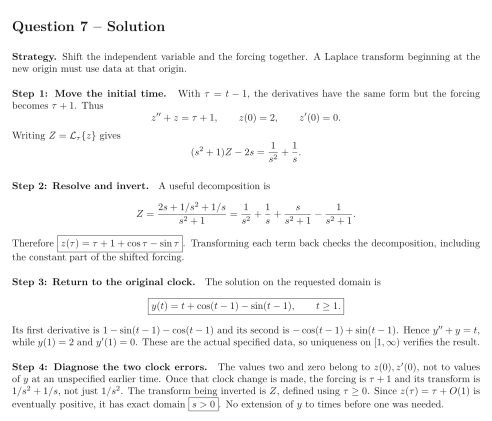
Step 1: Move the initial time. With , the derivatives have the same form but the forcing becomes . Thus Writing gives
Step 2: Resolve and invert. A useful decomposition is Therefore . Transforming each term back checks the decomposition, including the constant part of the shifted forcing.
Step 3: Return to the original clock. The solution on the requested domain is Its first derivative is and its second is . Hence , while and . These are the actual specified data, so uniqueness on verifies the result.
Step 4: Diagnose the two clock errors. The values two and zero belong to , not to values of at an unspecified earlier time. Once that clock change is made, the forcing is and its transform is , not just . The transform being inverted is , defined using . Since is eventually positive, it has exact domain . No extension of to times before one was needed.