Question 3
Use the ordinary one-sided Laplace transform for real . Seek an inverse continuous on and of exponential order; transforms agreeing for all sufficiently large have at most one inverse in this class.
Recover the inverse of Use the pairs for and , whose numerators are and , respectively, over .
Tasks
Complete the square and rewrite the numerator in terms of the shifted parameter.
Find and forward-check the inverse. Diagnose the candidate .
Express the inverse as with and . Find its first positive zero.
Give its exact real convergence interval and explain the roles of the decay envelope and oscillation frequency.
Show solutionHide solution
Question 3 – Solution
Strategy. Shift the numerator as well as the denominator; then distinguish phase, amplitude and exponential decay.
Step 1: Match the shifted pairs. The denominator is , while . Therefore
Step 2: Invert and diagnose the sign error. The matching time function is Its forward transform reproduces . The proposed candidate instead has numerator . Completing the square without adjusting the numerator loses a constant contribution.
Step 3: Recover phase and the first zero. In , compare coefficients: Both sine and cosine of are positive, so the specified quadrant removes any phase ambiguity. Starting at , the first zero occurs when :
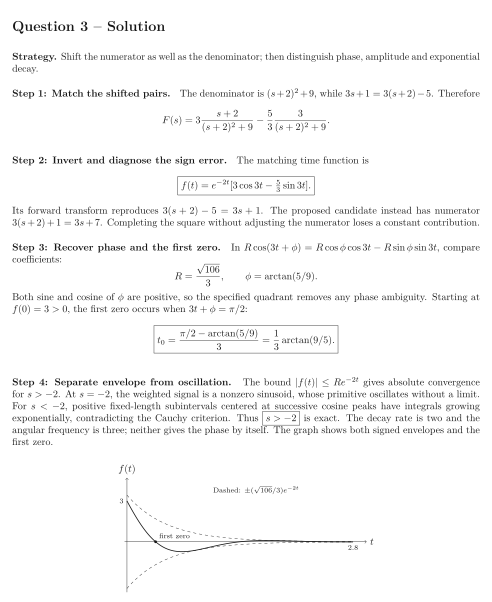
Step 4: Separate envelope from oscillation. The bound gives absolute convergence for . At , the weighted signal is a nonzero sinusoid, whose primitive oscillates without a limit. For , positive fixed-length subintervals centered at successive cosine peaks have integrals growing exponentially, contradicting the Cauchy criterion. Thus is exact. The decay rate is two and the angular frequency is three; neither gives the phase by itself. The graph shows both signed envelopes and the first zero.
See the diagram in the original worksheet below.