Question 2
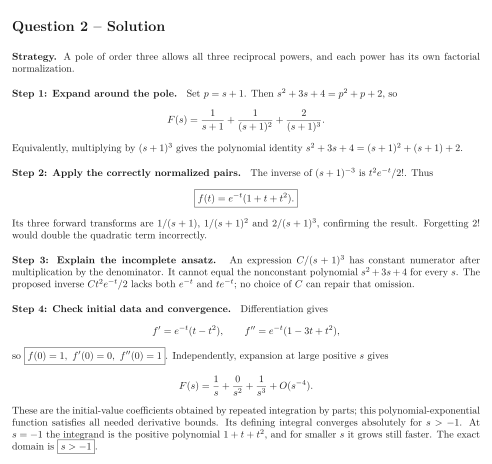
Use the ordinary one-sided Laplace transform for real . Seek an inverse continuous on and of exponential order; transforms agreeing for all sufficiently large have at most one inverse in this class.
Let You may use for nonnegative integers and .
Tasks
Find the complete partial-fraction expansion at the repeated pole.
Invert every term, explaining the factorial factors. Verify the transform of your answer.
A student includes only a term . Show why this cannot represent , and identify the missing time terms.
Compute and the exact convergence interval. Check the three initial quantities against the first three large- coefficients of .
Show solutionHide solution
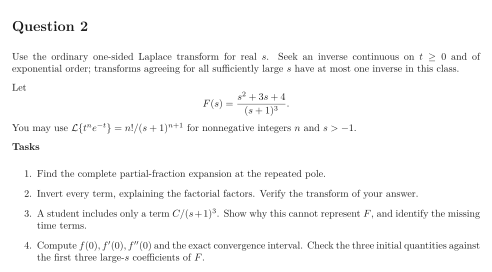
Question 2 – Solution
Strategy. A pole of order three allows all three reciprocal powers, and each power has its own factorial normalization.
Step 1: Expand around the pole. Set . Then , so Equivalently, multiplying by gives the polynomial identity .
Step 2: Apply the correctly normalized pairs. The inverse of is . Thus Its three forward transforms are , and , confirming the result. Forgetting would double the quadratic term incorrectly.
Step 3: Explain the incomplete ansatz. An expression has constant numerator after multiplication by the denominator. It cannot equal the nonconstant polynomial for every . The proposed inverse lacks both and ; no choice of can repair that omission.
Step 4: Check initial data and convergence. Differentiation gives so . Independently, expansion at large positive gives These are the initial-value coefficients obtained by repeated integration by parts; this polynomial-exponential function satisfies all needed derivative bounds. Its defining integral converges absolutely for . At the integrand is the positive polynomial , and for smaller it grows still faster. The exact domain is .