Question 8
For real , write where the integral converges.
Suppose is continuous, bounded and nonnegative on . Consider the candidate expression
Tasks
Derive the sign requirements on , and imposed by these hypotheses. State when .
Although for every , prove that it cannot be the transform of such a nonnegative .
Construct a continuous bounded sign-changing function whose transform is , using basic exponential pairs. Verify its sign change and full real convergence interval.
Compute and explain why positivity of a transform throughout does not imply positivity of its original function.
Show solutionHide solution
Question 8 – Solution
Strategy. Positivity of the transform is only one consequence of a nonnegative signal; parameter derivatives supply stronger necessary tests.
Step 1: Derive the necessary signs. If , then the kernels obtained by differentiating once or twice are dominated locally in by constant multiples of and . Differentiation under the integral is therefore justified, and If is not identically zero, continuity gives a positive interval contribution and hence for every .
Step 2: Test the positive candidate. Although , This contradicts the required nonpositive derivative. Thus no continuous bounded nonnegative signal can have this transform.
Step 3: Find a valid signed signal. Rewrite . The basic exponential integrals give The function is positive for , zero at one, and negative for . It is continuous and bounded. At or below , its eventually negative polynomial or growing tail has no finite improper integral, so the domain is exact.
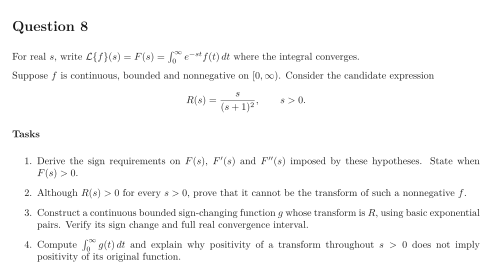
Step 4: Explain the weighted cancellation. At , the integral exists and equals , also verified by and . For positive , the extra weight suppresses the late negative portion more strongly, producing a positive transform. Consequently alone is insufficient to infer . The two plots show a sign-changing signal and its everywhere-positive transform on .
See the diagram in the original worksheet below.