Question 7
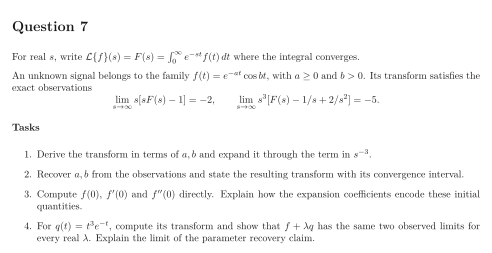
For real , write where the integral converges.
An unknown signal belongs to the family , with and . Its transform satisfies the exact observations
Tasks
Derive the transform in terms of and expand it through the term in .
Recover from the observations and state the resulting transform with its convergence interval.
Compute , and directly. Explain how the expansion coefficients encode these initial quantities.
For , compute its transform and show that has the same two observed limits for every real . Explain the limit of the parameter recovery claim.
Show solutionHide solution
Question 7 – Solution
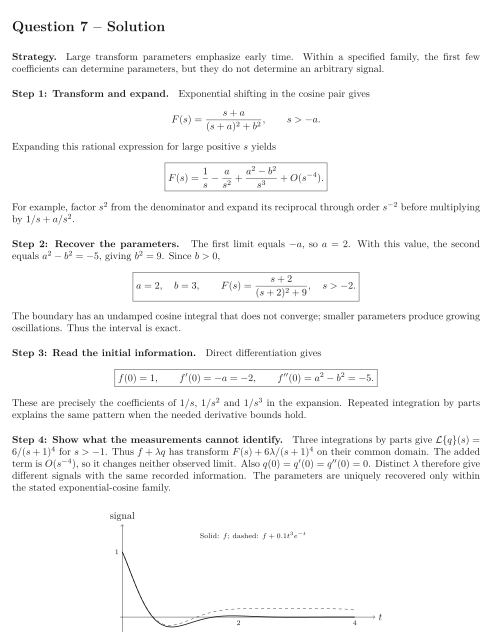
Strategy. Large transform parameters emphasize early time. Within a specified family, the first few coefficients can determine parameters, but they do not determine an arbitrary signal.
Step 1: Transform and expand. Exponential shifting in the cosine pair gives Expanding this rational expression for large positive yields For example, factor from the denominator and expand its reciprocal through order before multiplying by .
Step 2: Recover the parameters. The first limit equals , so . With this value, the second equals , giving . Since , The boundary has an undamped cosine integral that does not converge; smaller parameters produce growing oscillations. Thus the interval is exact.
Step 3: Read the initial information. Direct differentiation gives These are precisely the coefficients of , and in the expansion. Repeated integration by parts explains the same pattern when the needed derivative bounds hold.
Step 4: Show what the measurements cannot identify. Three integrations by parts give for . Thus has transform on their common domain. The added term is , so it changes neither observed limit. Also . Distinct therefore give different signals with the same recorded information. The parameters are uniquely recovered only within the stated exponential-cosine family.
See the diagram in the original worksheet below.