Question 5
Use causal one-sided Laplace transforms. Write for and for . Ordinary functions are zero for . Justify the table entries and operational rules you use; give exact expressions.
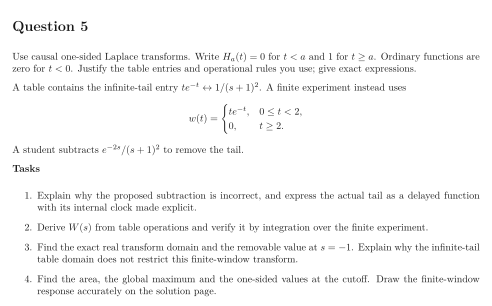
A table contains the infinite-tail entry . A finite experiment instead uses A student subtracts to remove the tail.
Tasks
Explain why the proposed subtraction is incorrect, and express the actual tail as a delayed function with its internal clock made explicit.
Derive from table operations and verify it by integration over the finite experiment.
Find the exact real transform domain and the removable value at . Explain why the infinite-tail table domain does not restrict this finite-window transform.
Find the area, the global maximum and the one-sided values at the cutoff. Draw the finite-window response accurately on the solution page.
Show solutionHide solution
Question 5 – Solution
Strategy. Removing an old tail requires its original age, not a fresh copy starting at zero.
Step 1: Identify the tail that must be removed. For , the old signal is . Thus The proposed subtraction instead removes , which has both the wrong age polynomial and the wrong exponential scale.
Step 2: Transform and check directly. For , the correct expression is Initially table operations justify it for . Independently put : . Integration by parts gives , agreeing with the table calculation and extending its formula to of either sign.
Step 3: Remove the singularity and identify the domain. A bounded finite interval makes this transform finite for every real . At the defining integral is . The numerator’s Taylor expansion is , so the apparent pole is removable. The two infinite-tail terms need only be transformed separately on their common domain; their difference has a larger actual domain.
Step 4: Record the geometric checks. The area is . Since , the unique global maximum is at . At the cutoff, while . The open dot marks the excluded left-hand value and the filled dot the actual value at ; no slanted segment bridges the jump.
See the diagram in the original worksheet below.
