Question 4
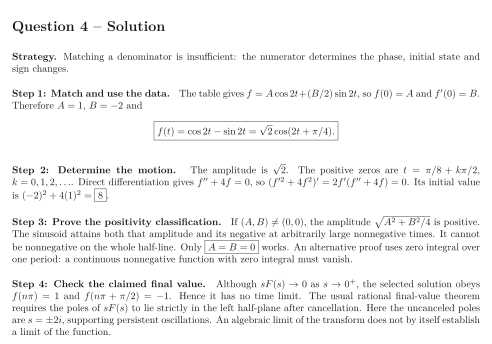
Use causal one-sided Laplace transforms. Write for and for . Ordinary functions are zero for . Justify the table entries and operational rules you use; give exact expressions.
An unknown function has transform where are real. Measurements give and .
Tasks
Invert the general transform by matching numerators to table entries, then recover from the data.
For the recovered function, find its amplitude, all positive zeros, and the conserved quantity .
Classify all real pairs for which the inverse is nonnegative for every . Prove the classification.
A student argues that proves . Refute the conclusion with two sequences of times and identify the missing hypothesis in that use of the final-value theorem.
Show solutionHide solution
Question 4 – Solution
Strategy. Matching a denominator is insufficient: the numerator determines the phase, initial state and sign changes.
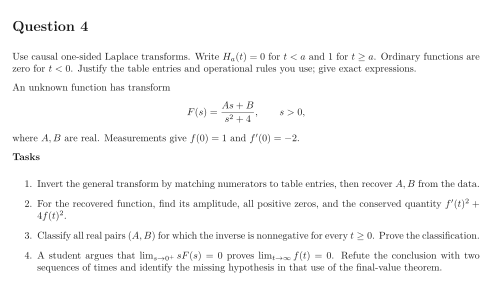
Step 1: Match and use the data. The table gives , so and . Therefore , and
Step 2: Determine the motion. The amplitude is . The positive zeros are , . Direct differentiation gives , so . Its initial value is .
Step 3: Prove the positivity classification. If , the amplitude is positive. The sinusoid attains both that amplitude and its negative at arbitrarily large nonnegative times. It cannot be nonnegative on the whole half-line. Only works. An alternative proof uses zero integral over one period: a continuous nonnegative function with zero integral must vanish.
Step 4: Check the claimed final value. Although as , the selected solution obeys and . Hence it has no time limit. The usual rational final-value theorem requires the poles of to lie strictly in the left half-plane after cancellation. Here the uncanceled poles are , supporting persistent oscillations. An algebraic limit of the transform does not by itself establish a limit of the function.