Question 7
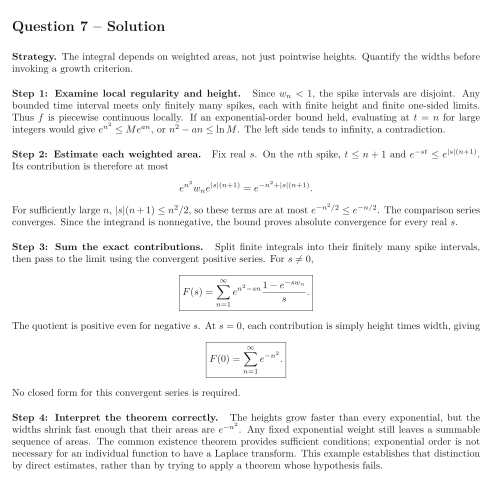
For real , use whenever this ordinary improper integral converges.
For each integer , let . Define a nonnegative signal by A function is of exponential order if for all sufficiently large , for some constants and real .
Tasks
Explain why is piecewise continuous on every finite interval but is not of exponential order.
Prove that its Laplace integral nevertheless converges absolutely for every real .
Express as a convergent series, treating separately.
Explain how the spike widths resolve the apparent conflict between arbitrarily large heights and convergence, and why the usual exponential-order theorem is not contradicted.
Show solutionHide solution
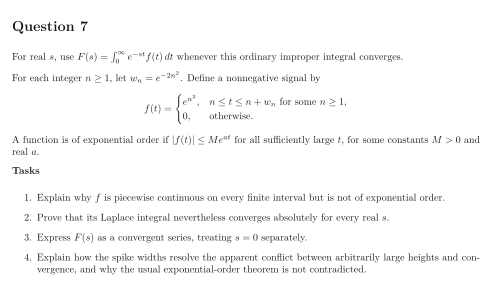
Question 7 – Solution
Strategy. The integral depends on weighted areas, not just pointwise heights. Quantify the widths before invoking a growth criterion.
Step 1: Examine local regularity and height. Since , the spike intervals are disjoint. Any bounded time interval meets only finitely many spikes, each with finite height and finite one-sided limits. Thus is piecewise continuous locally. If an exponential-order bound held, evaluating at for large integers would give , or . The left side tends to infinity, a contradiction.
Step 2: Estimate each weighted area. Fix real . On the th spike, and . Its contribution is therefore at most For sufficiently large , , so these terms are at most . The comparison series converges. Since the integrand is nonnegative, the bound proves absolute convergence for every real .
Step 3: Sum the exact contributions. Split finite integrals into their finitely many spike intervals, then pass to the limit using the convergent positive series. For , The quotient is positive even for negative . At , each contribution is simply height times width, giving No closed form for this convergent series is required.
Step 4: Interpret the theorem correctly. The heights grow faster than every exponential, but the widths shrink fast enough that their areas are . Any fixed exponential weight still leaves a summable sequence of areas. The common existence theorem provides sufficient conditions; exponential order is not necessary for an individual function to have a Laplace transform. This example establishes that distinction by direct estimates, rather than by trying to apply a theorem whose hypothesis fails.