Question 6
For real , use whenever this ordinary improper integral converges.
Compare and for , and write their transforms as and .
Tasks
Determine the real convergence set of each transform directly from the defining integral.
Complete the square to express through a Gaussian tail for every real . No special-function notation is required.
For a truncation at with , prove an explicit upper bound for the omitted tail of .
At , find the smallest integer for which your bound certifies an error at most . Explain why negative does not destroy convergence for .
Show solutionHide solution
Question 6 – Solution
Strategy. Compare the quadratic growth or decay with the linear term supplied by the Laplace weight, and use the completed square to bound numerical truncation.
Step 1: Classify both integrals. For any real , when , so on a half-line. Hence diverges for every real . For , A shifted Gaussian has an integrable tail and no finite-endpoint singularity, so converges absolutely for every real .
Step 2: Express the exact transform. Substitution gives The lower endpoint is allowed to be negative; the finite portion of the integral then remains harmless. This definite integral is an exact answer.
Step 3: Bound the omitted tail. Let . Since for , Consequently the positive truncation error satisfies The condition is part of the bound and cannot be dropped.
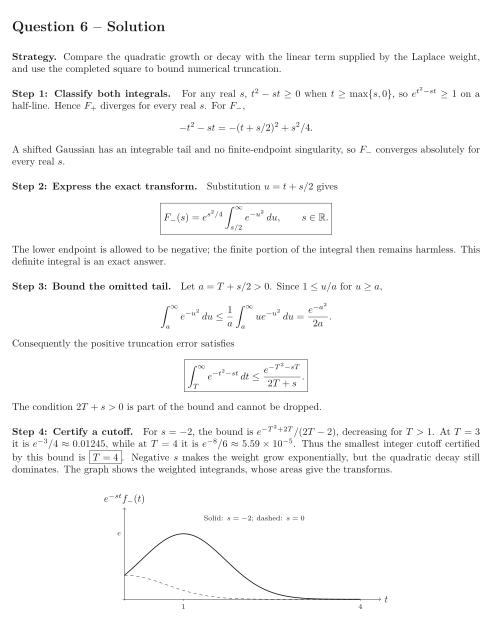
Step 4: Certify a cutoff. For , the bound is , decreasing for . At it is , while at it is . Thus the smallest integer cutoff certified by this bound is . Negative makes the weight grow exponentially, but the quadratic decay still dominates. The graph shows the weighted integrands, whose areas give the transforms.
See the diagram in the original worksheet below.