Question 2
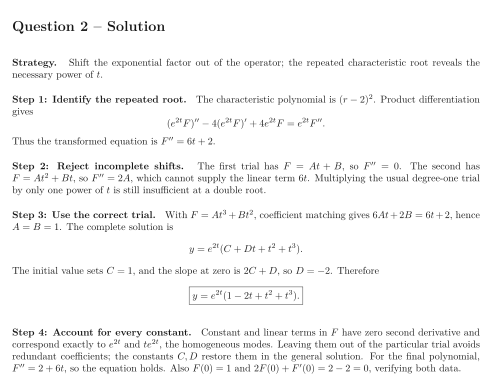
On , solve Three candidate trial forms are , and .
Tasks
Find the homogeneous roots and explain the resonance multiplicity. Derive the identity obtained by writing .
Test the first two trial forms and explain exactly why neither can produce the forcing.
Use the third trial to find a particular solution and then solve the initial-value problem.
Explain why the trial omits the constant and linear powers of , and why their omission loses no solution freedom. Verify the final equation and data.
Show solutionHide solution
Question 2 – Solution
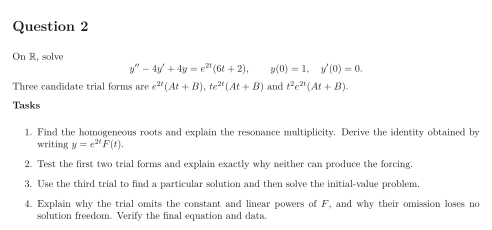
Strategy. Shift the exponential factor out of the operator; the repeated characteristic root reveals the necessary power of .
Step 1: Identify the repeated root. The characteristic polynomial is . Product differentiation gives Thus the transformed equation is .
Step 2: Reject incomplete shifts. The first trial has , so . The second has , so , which cannot supply the linear term . Multiplying the usual degree-one trial by only one power of is still insufficient at a double root.
Step 3: Use the correct trial. With , coefficient matching gives , hence . The complete solution is The initial value sets , and the slope at zero is , so . Therefore
Step 4: Account for every constant. Constant and linear terms in have zero second derivative and correspond exactly to and , the homogeneous modes. Leaving them out of the particular trial avoids redundant coefficients; the constants restore them in the general solution. For the final polynomial, , so the equation holds. Also and , verifying both data.