Question 1
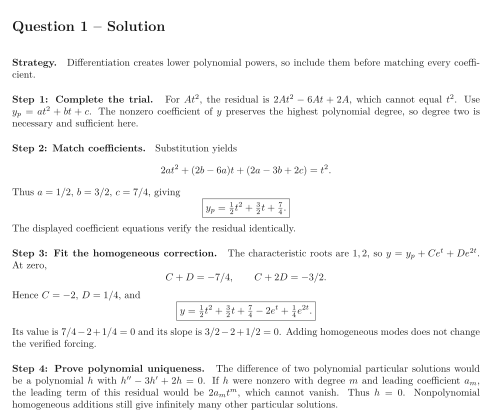
Consider the initial-value problem on A student proposes the particular trial because the forcing contains only a quadratic term.
Tasks
Explain why the proposed trial is insufficient. Choose the smallest complete polynomial trial and justify its degree.
Determine all coefficients of that trial and verify its residual.
Find the full initial-value solution, checking both data.
Prove that the polynomial particular solution is unique among polynomials, even though particular solutions in general are not unique.
Show solutionHide solution
Question 1 – Solution
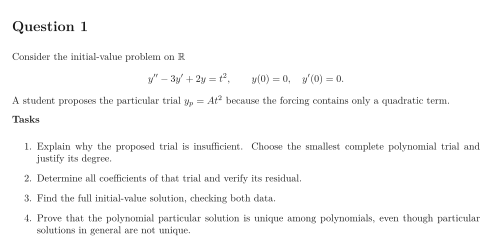
Strategy. Differentiation creates lower polynomial powers, so include them before matching every coefficient.
Step 1: Complete the trial. For , the residual is , which cannot equal . Use . The nonzero coefficient of preserves the highest polynomial degree, so degree two is necessary and sufficient here.
Step 2: Match coefficients. Substitution yields Thus , , , giving The displayed coefficient equations verify the residual identically.
Step 3: Fit the homogeneous correction. The characteristic roots are , so . At zero, Hence , , and Its value is and its slope is . Adding homogeneous modes does not change the verified forcing.
Step 4: Prove polynomial uniqueness. The difference of two polynomial particular solutions would be a polynomial with . If were nonzero with degree and leading coefficient , the leading term of this residual would be , which cannot vanish. Thus . Nonpolynomial homogeneous additions still give infinitely many other particular solutions.