Question 4
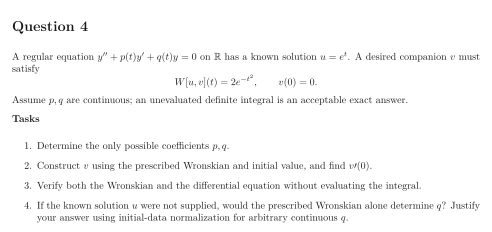
A regular equation on has a known solution . A desired companion must satisfy Assume are continuous; an unevaluated definite integral is an acceptable exact answer.
Tasks
Determine the only possible coefficients .
Construct using the prescribed Wronskian and initial value, and find .
Verify both the Wronskian and the differential equation without evaluating the integral.
If the known solution were not supplied, would the prescribed Wronskian alone determine ? Justify your answer using initial-data normalization for arbitrary continuous .
Show solutionHide solution
Question 4 – Solution
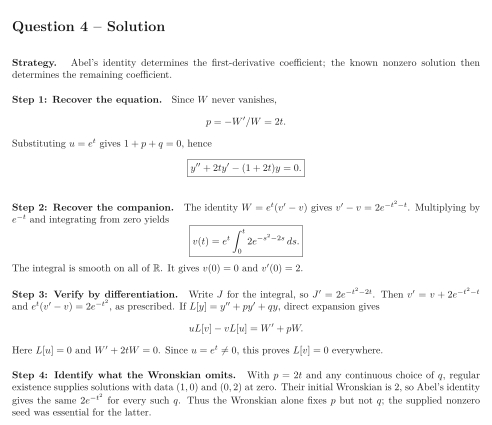
Strategy. Abel’s identity determines the first-derivative coefficient; the known nonzero solution then determines the remaining coefficient.
Step 1: Recover the equation. Since never vanishes, Substituting gives , hence
Step 2: Recover the companion. The identity gives . Multiplying by and integrating from zero yields The integral is smooth on all of . It gives and .
Step 3: Verify by differentiation. Write for the integral, so . Then and , as prescribed. If , direct expansion gives Here and . Since , this proves everywhere.
Step 4: Identify what the Wronskian omits. With and any continuous choice of , regular existence supplies solutions with data and at zero. Their initial Wronskian is , so Abel’s identity gives the same for every such . Thus the Wronskian alone fixes but not ; the supplied nonzero seed was essential for the latter.