Question 3
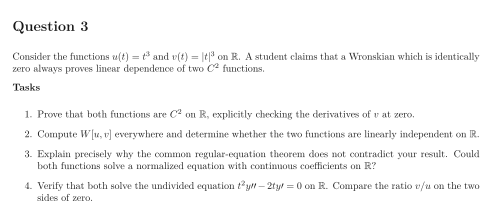
Consider the functions and on . A student claims that a Wronskian which is identically zero always proves linear dependence of two functions.
Tasks
Prove that both functions are on , explicitly checking the derivatives of at zero.
Compute everywhere and determine whether the two functions are linearly independent on .
Explain precisely why the common regular-equation theorem does not contradict your result. Could both functions solve a normalized equation with continuous coefficients on ?
Verify that both solve the undivided equation on . Compare the ratio on the two sides of zero.
Show solutionHide solution
Question 3 – Solution
Strategy. Check the counterexample directly, then identify the hypothesis missing from the student’s assertion.
Step 1: Check regularity. For , and . At zero, These agree continuously with the formulas away from zero, so is ; is a polynomial and is smooth.
Step 2: Compare the Wronskian and independence. On , ; on , . Thus on each side, and at zero both data columns are zero, so . Yet on all of forces on the positive side and on the negative side. Hence : the functions are independent on .
Step 3: Restore the missing hypothesis. The zero-Wronskian implication requires solutions of one common regular homogeneous linear equation on a connected interval, not merely two functions. The nonzero solution would have zero value and slope at zero, contradicting regular uniqueness. Thus no normalized equation with continuous coefficients on can have both as solutions.
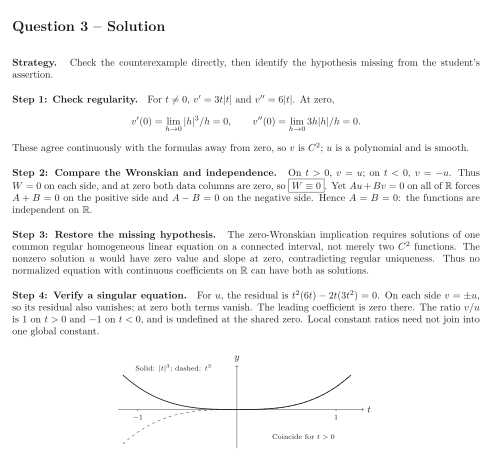
Step 4: Verify a singular equation. For , the residual is . On each side , so its residual also vanishes; at zero both terms vanish. The leading coefficient is zero there. The ratio is on and on , and is undefined at the shared zero. Local constant ratios need not join into one global constant.
See the diagram in the original worksheet below.