Question 8
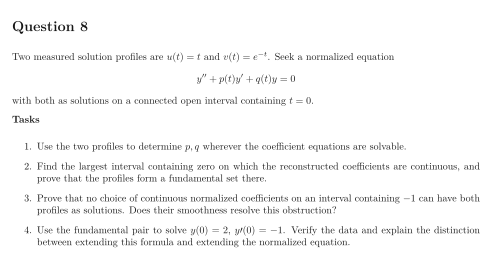
Two measured solution profiles are and . Seek a normalized equation with both as solutions on a connected open interval containing .
Tasks
Use the two profiles to determine wherever the coefficient equations are solvable.
Find the largest interval containing zero on which the reconstructed coefficients are continuous, and prove that the profiles form a fundamental set there.
Prove that no choice of continuous normalized coefficients on an interval containing can have both profiles as solutions. Does their smoothness resolve this obstruction?
Use the fundamental pair to solve , . Verify the data and explain the distinction between extending this formula and extending the normalized equation.
Show solutionHide solution
Question 8 – Solution
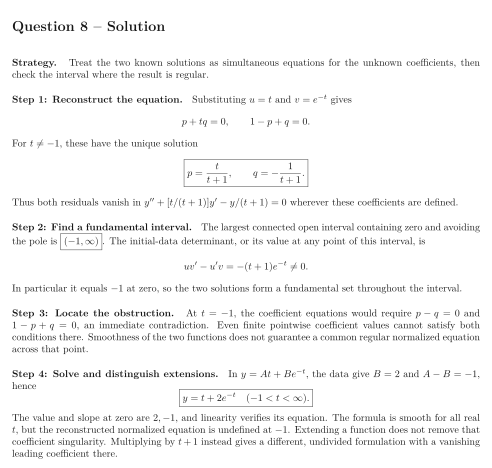
Strategy. Treat the two known solutions as simultaneous equations for the unknown coefficients, then check the interval where the result is regular.
Step 1: Reconstruct the equation. Substituting and gives For , these have the unique solution Thus both residuals vanish in wherever these coefficients are defined.
Step 2: Find a fundamental interval. The largest connected open interval containing zero and avoiding the pole is . The initial-data determinant, or its value at any point of this interval, is In particular it equals at zero, so the two solutions form a fundamental set throughout the interval.
Step 3: Locate the obstruction. At , the coefficient equations would require and , an immediate contradiction. Even finite pointwise coefficient values cannot satisfy both conditions there. Smoothness of the two functions does not guarantee a common regular normalized equation across that point.
Step 4: Solve and distinguish extensions. In , the data give and , hence The value and slope at zero are , and linearity verifies its equation. The formula is smooth for all real , but the reconstructed normalized equation is undefined at . Extending a function does not remove that coefficient singularity. Multiplying by instead gives a different, undivided formulation with a vanishing leading coefficient there.