Question 7
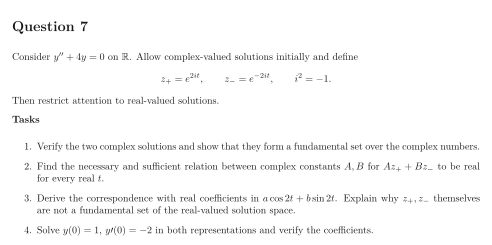
Consider on . Allow complex-valued solutions initially and define Then restrict attention to real-valued solutions.
Tasks
Verify the two complex solutions and show that they form a fundamental set over the complex numbers.
Find the necessary and sufficient relation between complex constants for to be real for every real .
Derive the correspondence with real coefficients in . Explain why themselves are not a fundamental set of the real-valued solution space.
Solve , in both representations and verify the coefficients.
Show solutionHide solution
Question 7 – Solution
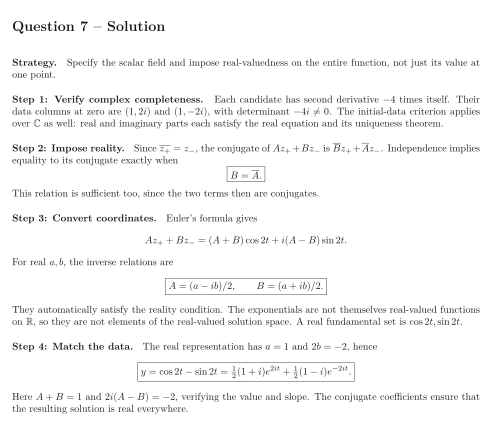
Strategy. Specify the scalar field and impose real-valuedness on the entire function, not just its value at one point.
Step 1: Verify complex completeness. Each candidate has second derivative times itself. Their data columns at zero are and , with determinant . The initial-data criterion applies over as well: real and imaginary parts each satisfy the real equation and its uniqueness theorem.
Step 2: Impose reality. Since , the conjugate of is . Independence implies equality to its conjugate exactly when This relation is sufficient too, since the two terms then are conjugates.
Step 3: Convert coordinates. Euler’s formula gives For real , the inverse relations are They automatically satisfy the reality condition. The exponentials are not themselves real-valued functions on , so they are not elements of the real-valued solution space. A real fundamental set is .
Step 4: Match the data. The real representation has and , hence Here and , verifying the value and slope. The conjugate coefficients ensure that the resulting solution is real everywhere.