Question 2
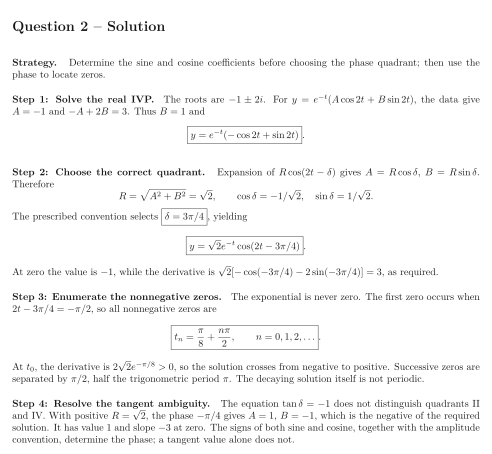
Consider Use the phase convention with and .
Tasks
Solve the IVP in sine/cosine form.
Determine in the stated convention and verify the initial value and derivative in phase form.
Find every zero for , the sign immediately after the first zero, and the spacing between successive zeros.
Explain why solving only can give the wrong phase quadrant. Diagnose the choice with positive amplitude for this IVP.
Show solutionHide solution
Question 2 – Solution
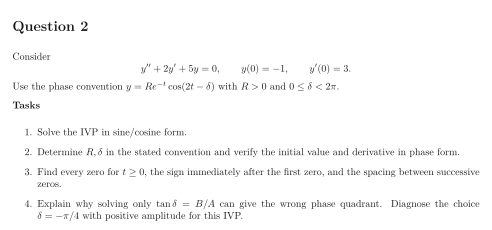
Strategy. Determine the sine and cosine coefficients before choosing the phase quadrant; then use the phase to locate zeros.
Step 1: Solve the real IVP. The roots are . For , the data give and . Thus and
Step 2: Choose the correct quadrant. Expansion of gives , . Therefore The prescribed convention selects , yielding At zero the value is , while the derivative is , as required.
Step 3: Enumerate the nonnegative zeros. The exponential is never zero. The first zero occurs when , so all nonnegative zeros are At , the derivative is , so the solution crosses from negative to positive. Successive zeros are separated by , half the trigonometric period . The decaying solution itself is not periodic.
Step 4: Resolve the tangent ambiguity. The equation does not distinguish quadrants II and IV. With positive , the phase gives , , which is the negative of the required solution. It has value 1 and slope at zero. The signs of both sine and cosine, together with the amplitude convention, determine the phase; a tangent value alone does not.