Question 1
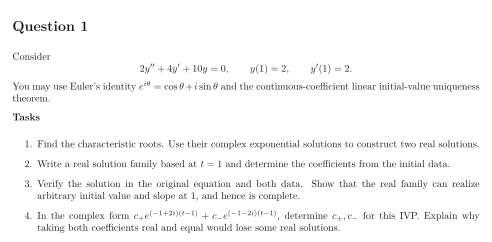
Consider You may use Euler’s identity and the continuous-coefficient linear initial-value uniqueness theorem.
Tasks
Find the characteristic roots. Use their complex exponential solutions to construct two real solutions.
Write a real solution family based at and determine the coefficients from the initial data.
Verify the solution in the original equation and both data. Show that the real family can realize arbitrary initial value and slope at 1, and hence is complete.
In the complex form , determine for this IVP. Explain why taking both coefficients real and equal would lose some real solutions.
Show solutionHide solution
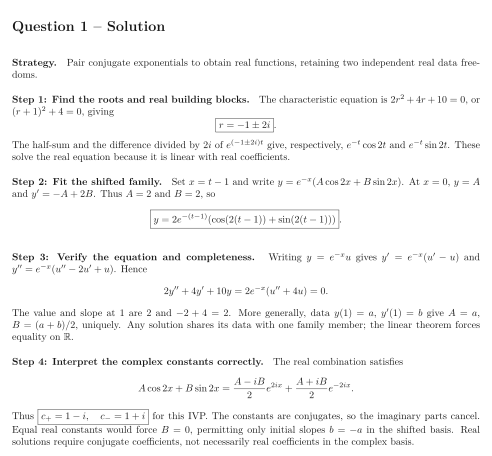
Question 1 – Solution
Strategy. Pair conjugate exponentials to obtain real functions, retaining two independent real data freedoms.
Step 1: Find the roots and real building blocks. The characteristic equation is , or , giving The half-sum and the difference divided by of give, respectively, and . These solve the real equation because it is linear with real coefficients.
Step 2: Fit the shifted family. Set and write . At , and . Thus and , so
Step 3: Verify the equation and completeness. Writing gives and . Hence The value and slope at 1 are and . More generally, data , give , , uniquely. Any solution shares its data with one family member; the linear theorem forces equality on .
Step 4: Interpret the complex constants correctly. The real combination satisfies Thus for this IVP. The constants are conjugates, so the imaginary parts cancel. Equal real constants would force , permitting only initial slopes in the shifted basis. Real solutions require conjugate coefficients, not necessarily real coefficients in the complex basis.