Question 3
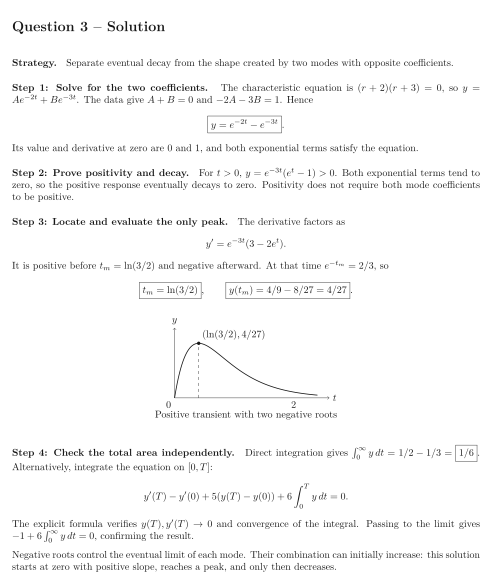
A transient response satisfies Only is considered in the qualitative questions.
Tasks
Solve the initial-value problem using its real distinct roots.
Prove that for , even though as .
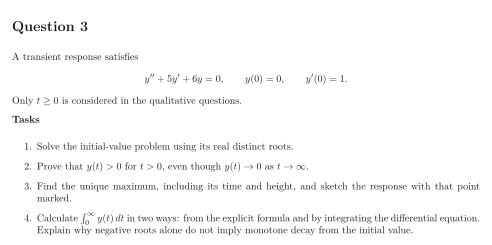
Find the unique maximum, including its time and height, and sketch the response with that point marked.
Calculate in two ways: from the explicit formula and by integrating the differential equation. Explain why negative roots alone do not imply monotone decay from the initial value.
Show solutionHide solution
Question 3 – Solution
Strategy. Separate eventual decay from the shape created by two modes with opposite coefficients.
Step 1: Solve for the two coefficients. The characteristic equation is , so . The data give and . Hence Its value and derivative at zero are 0 and 1, and both exponential terms satisfy the equation.
Step 2: Prove positivity and decay. For , . Both exponential terms tend to zero, so the positive response eventually decays to zero. Positivity does not require both mode coefficients to be positive.
Step 3: Locate and evaluate the only peak. The derivative factors as It is positive before and negative afterward. At that time , so
See the diagram in the original worksheet below.
Step 4: Check the total area independently. Direct integration gives . Alternatively, integrate the equation on : The explicit formula verifies and convergence of the integral. Passing to the limit gives , confirming the result.
Negative roots control the eventual limit of each mode. Their combination can initially increase: this solution starts at zero with positive slope, reaches a peak, and only then decreases.